National park to drive revival of wild pandas
 |
|
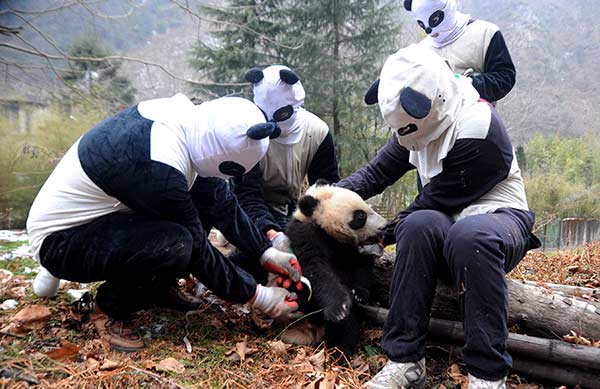
Researchers dressed as pandas conduct a checkup on a cub at the Hetaoping reintroduction base in Sichuan province.Provided To China Daily |
A new facility will be established to promote the protection and procreation of the endangered species. Liu Wei, Feng Changyong and Zhou Xiangji report for Xinhua China Features.
China plans to build a Giant Panda National Park spanning three provinces to help the endangered animals mingle and enrich their gene pool.
Pandas isolated on six mountains in the provinces of Gansu, Shaanxi and Sichuan will be able to come together in the proposed park, which will cover 27,134 square kilometers, three times the area of Yellowstone National Park in the United States.
It will have a core area, protecting pandas in 67 existing reserves as well as another 8,000 endangered animals and plants.
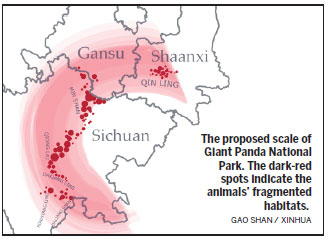
Like many endangered species, pandas are suffering loss and fragmentation of their habitat as a result of natural disasters, climate change and expanding human activity.
The problem is exacerbated by the multiple administrations controlling the three provinces, because jurisdiction becomes blurred when pandas cross provincial boundaries.
The park will solve the problem. When it is complete, the pandas will be able to roam freely between their far-flung habitats. It will also lead to the relocation of a lot of people - for example, at least 170,000 people in Sichuan will have to relocate to establish the core protection area.
"Unlike nature reserves, the park will not stand alone. China will formulate an overall plan for the national park system. It will be a haven of biodiversity and will provide protection for the whole ecological system," said Hou Rong, director of the Chengdu Research Base of Giant Panda Breeding in Sichuan.
According to the plan, China's national park system will comprise the Giant Panda National Park and eight other facilities devoted to endangered species and the headwaters of major rivers. Last year, the central government endorsed reform plans to "advance ecological progress", which included the plan to establish national parks.
Hou said the park will offer residents new homes and jobs. Many could be employed as tourist guides and as construction workers on infrastructure projects, so people and nature will benefit together.
People have lived in panda reserves for generations, but they cut bamboo shoots and grazed their livestock on hills, eating into the pandas' habitat and disrupting their lives.
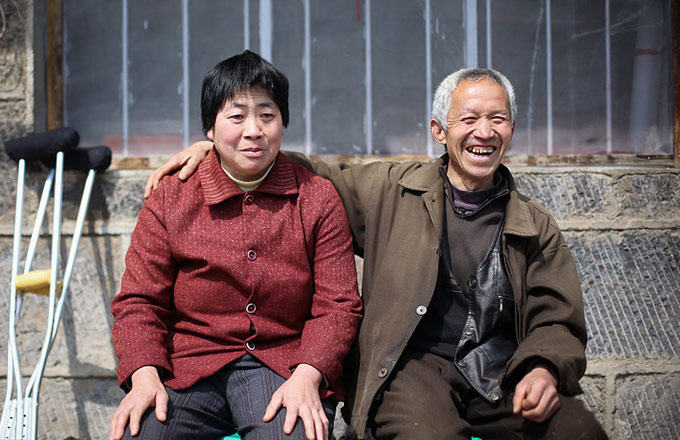
Qubie Mazi, a member of the Yi ethnic group, has lived in Sichuan's Hei Hezi village for 40 years, making a living by growing potatoes and collecting herbs. A panda reserve in the village is a key corridor connecting populations on nearby Liangshan Mountain.

Poverty once drove the villagers to poach pandas, but after a penalty-and-bonus system was introduced, they learned to value the national treasures and now cherish them.
"I saw a panda in one of the village houses a month ago. I guess he came to look for food or company. I know that when they need to mate, they go to the other side of the mountain. When I discover something unusual about the pandas, I report it to the reserve," Qubie said.
Asked how he feels about making way for pandas, he said, "I will move, providing I can have a new home and a new job."
According to Heng Yi, a senior member of staff at the China Conservation and Research Center for the Giant Panda, higher living standards would benefit both the local population and the pandas.
"We should lead the locals to protect the environment, not spoil it. The key measure is to help people live sustainable lives and to get them out of poverty. Once they have access to electricity, they will stop cutting down bamboo. If they have decent jobs and steady incomes, they won't risk poaching pandas," he said.