The appliance of science cleans Lake Taihu
New technologies are helping the famous landmark in East China to recover from years of severe pollution. Zhang Zhihao reports from Wuxi, Jiangsu province.
 |
|
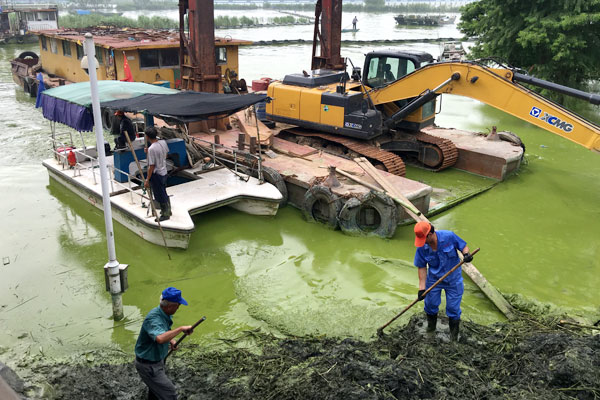
Workers remove blue-green algae from Lake Taihu in Wuxi, Jiangsu province.[Photo by Shuai Ge/ China Daily] |
For generations, poets used the term bishui, or "emerald water", to describe Lake Taihu, China's third-largest freshwater body, famed for its scenery and clear water that reflected the surrounding green hills.
The lake, which straddles the provinces of Jiangsu and Zhejiang in East China, is a cradle of fisheries and tourism. It is also the water source for industries and cities, from Wuxi in Jiangsu to Shanghai, nurturing more than 44 million people.
As nearby cities flourished during the past three decades, industrial effluent and waste from human activities ravaged the lake. A buildup of nutrients, often caused by fertilizers leaking into the water, resulted in eutrophication, a process that occurs when blue-green algae blooms and strips the oxygen from the water, causing it to stagnate and become putrid, tea-green sludge.
"It's a terrible eyesore," said Shen Ji, director of the Nanjing Institute of Geography and Limnology at the Chinese Academy of Sciences. According to Ji, China has about 920 freshwater lakes, most of them located along the middle and lower stretches of the Yangtze River, and more than 85 percent have been affected by algae pollution.
Now, the academy's scientists are trying to turn the tide via new technology: from bionic platforms that "eat" algae, to a giant razor that "shaves" the sediment, and a powder that turns algae into stone.
Although still in their infancies, these technologies, coupled with improved monitoring and prediction systems, have raised the amount of algae collected at the annual clean up from 0.8 million tons in 2008 to 1.6 million tons last year, according to Qin Boqiang, director of the academy's Taihu Laboratory for Lake Ecosystem Research.
"It will take decades for Taihu to fully recover," Qin said, adding that China isn't the only country facing the problem. "From Lake Okeechobee in the United States to the Nakdong River in the Republic of Korea, algae pollution has become a global ecological hazard. But these new technologies are helping us to make great progress, and we hope our experience at Taihu will help other countries to tackle the issue."
Inspired by nature
Silver carp has long been famous as a classic Chinese dish, but the fish is now also the inspiration for pollution control. Over the course of its life, one silver carp can consume 50 kilograms of algae, but dumping a large number of them into the lake would be expensive and could disturb the delicate ecological balance.
In response, Li Wenchao, an environmental engineer at the academy, devised a way to emulate the fish's "feast-and filter" mechanism and built a bionic platform that removes algae in an efficient, environmentally friendly way.
The 12-meter-long, 11-meter-wide floating platform loaded with filters is modeled on the gills of the silver carp. It travels across the water at 5 km an hour, gulping the algae in its path and leaving a trail of filtered water in its wake.
"It is like a vacuum cleaner for algae," Qin said. "The platform eats the algae, filters and shreds it through 200 layers of 'teeth', and then concentrates it into a thick pulp which is stored on deck. The clean water is then pumped back into the lake.
Traditionally, floating algae is cleared with large hand-held nets, which is slow, costly and ineffective. The platform can clear algae invisible to the naked eye, and can clean 1 metric ton of water for less than 0.05 yuan. It can be used all day without damaging the environment.
The prototype was first used in 2011, but by last year, newer, more-compact models had emerged. About 20 lakes and reservoirs now use the platform, ranging from Lake Xingyun in Yunnan province in the south of the country to the Yuqiao reservoir in Tianjin in the north.
The downside is that the platform costs about 2 million yuan ($290,000) and it is only effective in medium or large lakes, meaning its use is limited to waters that have economic significance, such as tourist attractions and reservoirs, according to Qin. "Even so, the bionic platform is an effective method of emergency algae control," he said.