Still safeguarding his home waters
Without his walking stick and mud-soiled shoes, it would be easy to mistake the silver-haired, softly spoken Qin Boqiang for a professor of literature. Instead, he is the chief ecologist for Lake Taihu.
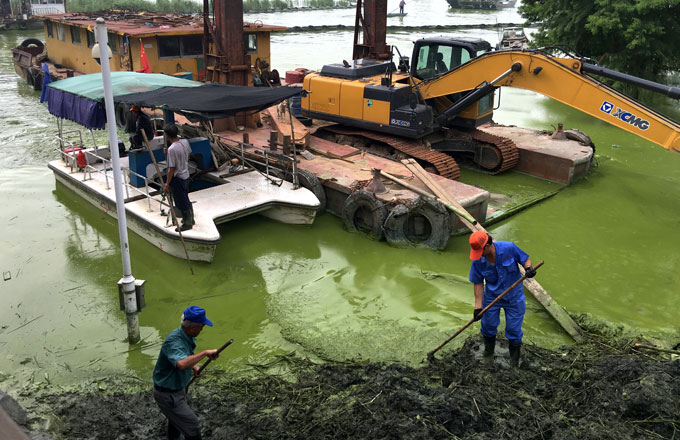
The 54-year-old, who was born and raised on Xishan Island in the southern part of lake, said the pea-green eyesore "smells like dead fish".
Qin graduated in hydro-engineering from Hohai University in Jiangsu province, China's top school for water studies, and studied physical geography at Lund University in Sweden as part of a fellowship exchange program. In 1996, he began working for the Taihu Laboratory for Lake Ecosystem Research at the Chinese Academy of Sciences.

"Taihu's water gave life to me, so it is my personal mission to save it," he said, recalling how his expertise was put to the test by a crisis a decade ago.
In May 2007, an algae outbreak overwhelmed a waterworks that supplied Wuxi, a city on Taihu's northern shore, leaving more than 2 million people without clean water for a week. It was a wakeup call for the local government, which pledged to clean up the mess and guarantee water security.
Along with other experts, Qin locked himself in a hotel room in Wuxi and tried to come up with both immediate and long-term solutions. "It turned out to be more difficult than anyone had anticipated," he said.
"Taihu is like a giant lake in a pan, so despite its large surface area, its environmental capacity is actually very limited. The deepest spot is only 3 meters, so strong winds can drastically change the water dynamics, which can easily spread pollutants and mess up our data."
Ten years ago, much less research had been conducted into shallow lakes compared with deep ones.
"We had no previous solutions to consult, so everything was based on trial and error," he said. Qin repeated what he told an expert advisory committee: "The source of pollution must be stopped before any other restoration program can take effect."
To reduce the number of pollution sources, the local authorities closed or relocated hundreds of factories and plants around the lake, built better sewage and waste-disposal infrastructures and implemented strict regulations on the release of effluents.
For Qin, there is still much to do: "The battle is far from over."