Tongzhou heads back into the future
 |
|
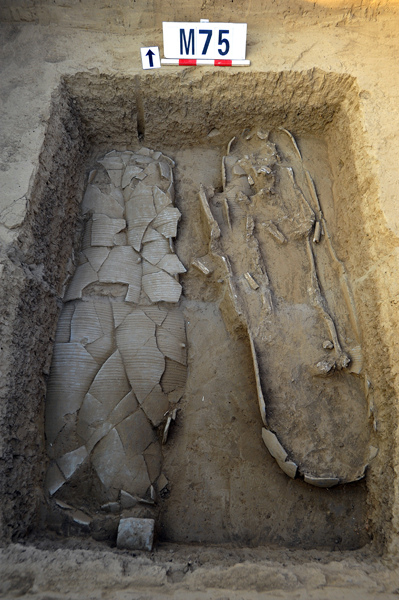
An adult urn burial site from the Warring States Period (475-221 BC) discovered in Hugezhuang. [Photo/China Daily] |
"The tombs are precious treasures, but they are also more than that. As a nation, we don't lack gold, but we do lack a common spirit. The 1,000-plus tombs reflect how Chinese culture developed during different periods, which can sometimes help us to understand and solve modern problems."
About 80 percent of the tombs date from the Han Dynasty, with 163 from the Western Han (206 BC-AD 24) and 696 from the Eastern Han (25-220).
The archaeologists also discovered 62 tombs in Tongzhou's Hugezhuang village that ranged from the late Warring States Period to the Western Han Dynasty. All of them contained burial urns.
Guo Jingning, deputy head of the Beijing Cultural Relics Research Institute, said it's extremely rare to discover such a large number of relics in one place.
"In addition to the number of urn-burial tombs, they are also of different types. We discovered six or seven different decorative patterns on them, which is very unusual," he said.
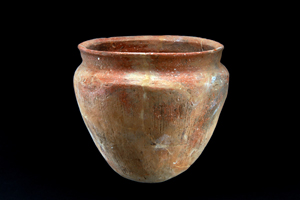
The urns were mainly used for the burial of children, but also sporadically for adults, and were favored because they prevented wild animals from desecrating the bodies. In addition, some researchers believe the shape of the urns is reminiscent of a womb, which was regarded as accelerating the rebirth of the dead.
The archaeological team also discovered 26 counting rods-tools made from bone that were used to perform calculations-in Tongzhou's Houbeiying village. Counting rods have also been discovered in other parts of China and are considered to have been important tools during the Western Han Dynasty.
Feng Lisheng, a professor who specializes in ancient texts at Tsinghua University in Beijing, said it was the first time that such a large number of counting rods had been discovered in Beijing, and noted that most of them were intact and well-preserved.
Ancient city
"The city was for people to live in while they were alive and the tombs were used for burying people when they died. Those factors form a full picture of society that will allow us to research the use of space and structures and the human habits prevalent at the time," said Liu, director of the Institute of Archeology.
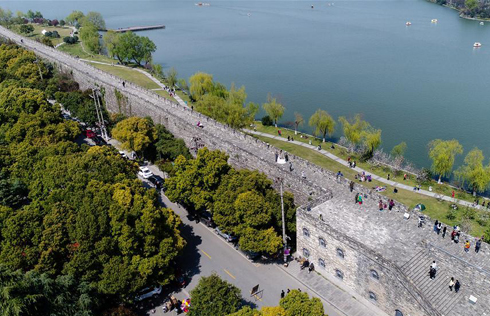
The archaeologists also unearthed the complete remains of the ancient city of Lucheng, founded during the Han Dynasty. The discovery included a road dating back to the Ming and Qing dynasties, and the remains of a moat from the Liao and Jin dynasties that was 30 to 50 meters wide.