Dried-up Har Lake reappears in desert
 |
|
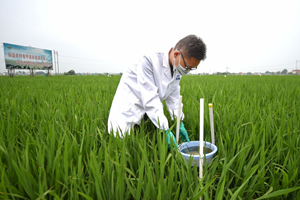
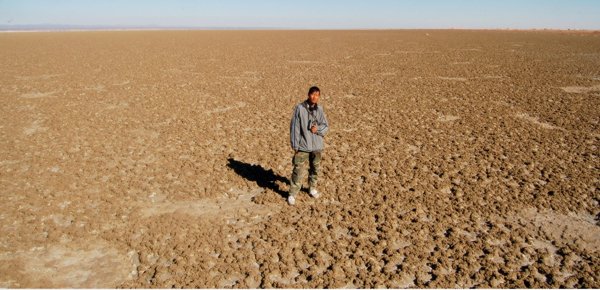
Li Fei, a postgraduate student from Beijing Forestry University, investigates Har Lake in 2007. [Photo/Xinhua] |
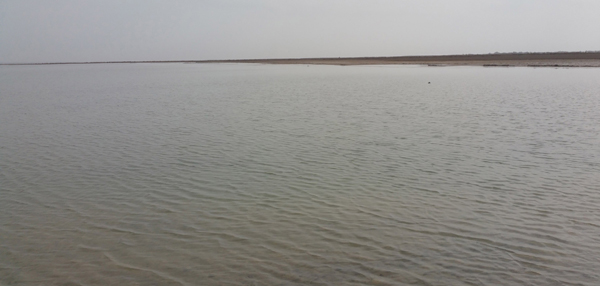
Har Lake, which dried up more than 50 years ago, has reappeared in the Gobi Desert in Gansu province.
The 24-square-kilometer body of water is 33 kilometers from Dunhuang, once a major stop on the Silk Road and famous for its Mogao Grottoes, according to a report by Science and Technology Daily.
"The spectacular view has not occurred overnight. Several years' efforts in dredging and repairing local river channels, in addition to a high level of precipitation last year, have brought the lake back to life," said Sun Zhicheng, head of the research department at Gansu Dunhuang West Lake National Nature Reserve Administration.
At one point in time, the lake is believed to have reached 77 sq km. However, the lake dried up in the 1970s.
"Lakes and marsh areas in Dunhuang reduced in size by 66.8 percent between 1973 and 2007, which resulted in the desertification of the land," said Yu Xinhua, deputy director of the Dunhuang water resources bureau.
Yu said Dunhuang faced increasing ecological problems because the population increased in the city's Danghe River area.
The reappearance of the lake was a result of water projects that have introduced more water to help Dunhuang improve its environment.
 |
|
The lake is pictured on March 19. [Photo/Xinhua] |
The Crescent Spring, regarded as a natural wonder in the Gobi Desert and located about 6 km south of Dunhuang, is a major tourist attraction in Gansu. The spring will also benefit from the increased water resources, according to Wu Jinkui, a research fellow at the Chinese Academy of Sciences' Northwest Institute of Eco-Environment and Resources.
The formation of Har Lake means a rise in the level of underground water, which is direct proof of an enhanced ecological environment, Wu said.
Last year, more than 150 million cubic meters of water flowed underground from the Shule River and slowed down the pace of desertification, he added.
However, according to the researchers, Har Lake might disappear this year when there is no water supply.
Wu said the lake might not remain after May because when the temperature increases, the rate of evaporation rises.
"If the lake fails to gather enough water in spring, it is likely to disappear in summer," he added.
Zhang Yi and Yuan Hui contributed to this story.