Skulls offer new evidence of human evolution in China
 |
|
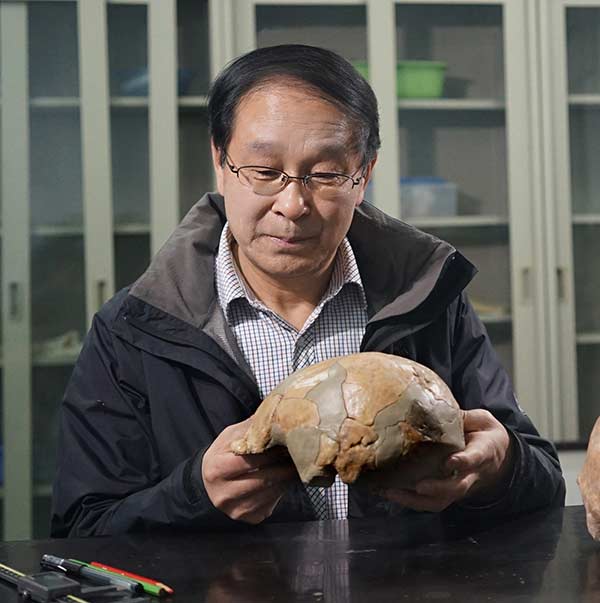
Researcher Li Zhanyang holds a restored skull model. [Photo/China Daily] |
ZHENGZHOU - New evidence has emerged that prehistoric hominids in northern China might have been hybrids of the indigenous population and Europeans, challenging the popular view of humankind's African origin.
Human cranial fossil remains from 105,000 to 125,000 years ago, found in Xuchang in Central China's Henan province, share characteristics of Chinese hominids, early modern humans and Neanderthals, a species named for the Neanderthal region of Germany, according to a report in Science magazine on Thursday.
Research on two skulls, Xuchang 1 and Xuchang 2, discovered in 2007 and 2014 respectively, show a similar occipital bone and inner ear labyrinth structure to Neanderthals, said Li Zhanyang, first author of the report and a researcher with the Henan provincial institute of cultural heritage and archaeology.
The Xuchang crania also had primitive features of Homo erectus pekinensis, or Peking Man, including a low neurocranial vault, flat neurocranium and short mastoid with inward slopes.
"The Xuchang humans lived between Peking Man (about 200,000 and 700,000 years ago) and early modern humans in north China (about 40,000 years ago), proving continuity of human evolution in north China," said Li.
Li said that Xuchang 1 has features of early modern humans and was very likely a direct ancestor of modern northern Chinese. Xuchang, located to the north of the Huaihe River, is geographically in north China.
There is a firm consensus on the African origin of our species, but there are two competing views in paleoanthropology about the origin of extant modern humans, or Homo sapiens, the African view and the multiregional view.
Neanderthals thrived in Europe, northern Africa and western Asia between 30,000 and 130,000 years ago, according to Li.
"It is the first time fossils bearing characteristics of the Neanderthals have been found in east Asia," said Li, who has led a 12-year excavation in Xuchang.
The Xuchang crania will influence research on the origin of modern humans, said Erik Trinkaus, co-author of the report and a professor with Washington University in St Louis.
Two years ago, Li formed an international team working on the Xuchang fossils with scientists from the Chinese Academy of Sciences, Peking University, East China Normal University and Washington University in St Louis.
Researchers used CT scanning and 3D technology to make comparisons with human fossils found in other parts of the world.
"Xuchang Man is a new species," said Li, however, a DNA analysis of the fossils has yet to be satisfactorily carried out.
Xinhua