Public participation key for rule of law, says expert
 |
|
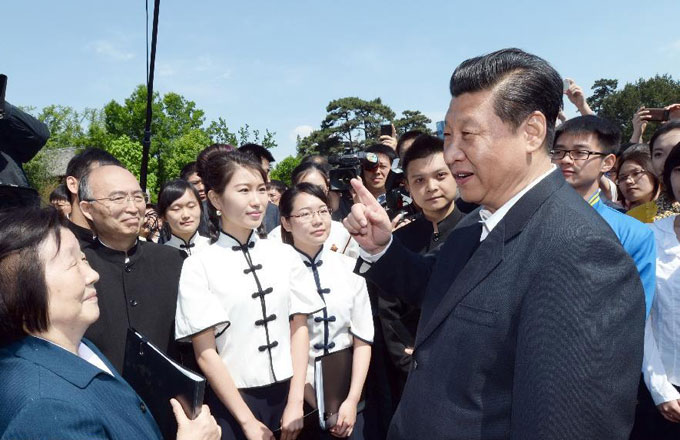
Yang Tuan, a social policy researcher at Chinese Academy of Social Sciences,?played a major role in pushing through China's first Charity Law. [Photo/Xinhua] |
The law should protect the rights of citizens to do charity and public services, which can be achieved only through the wide participation of citizens in legislation, said Yang Tuan, a researcher on social policy at the Chinese Academy of Social Sciences.
Yang has played a major role in pushing through China's first Charity Law.
The 69-year-old has worked in public welfare and charity sector for more than 20 years. Since 1993, she has held influential positions successively in China Population Welfare Foundation and China Charity Foundations.
In 1998, she became a researcher at the Chinese Academy of Social Sciences, a government-supported think tank.
"At that time, there was no research on charity in the country," said Yang.
When she began working in the charity sector, Yang heard a lot of negative voices about charity. Some people equaled it to "people doing it out of compassion" and "hypocrisy".
Yang said the society's attitude toward charity took a turn in 1998, when massive floods broke out in several major rivers across the country, killing about 3,000.
When people learned the news of the scale of the disaster, they donated more than 11 billion yuan ($1.6 billion) to help the victims. It marked the first nationwide charity movement in the history of the New China.
In the decade from 1998 to 2008, the idea of charity came into the horizon of more and more people. After the magnitude-7.8 Wenchuan earthquake jolted Sichuan province on May 12, 2008, the donation nationwide amounted to more than 100 billion yuan.
People started to realize that charity was not only "a private and individual behavior", rather, it could be "an action carried out by many people for the benefits of many people", said Yang.
China's first Charity Law came into force in September 2016. It is seen as the fundamental law of China's philanthropy, aiming to promote philanthropic culture.
The law eases restrictions on the fund-raising and operational activities of charity groups, tightens supervision of their internal management and promises tax benefits for the sector.
Yang said the law was a landmark because it was the result of "an open-door legislation". She said before the law was passed by the nation's top legislature, it had been discussed widely in the civil society.
"In the past, all big issues were pushed forward and decided by the government," said Yang. "The legislation of the Charity Law marked a positive change in the mechanism driving forward the society".
It was the first time that non-governmental organizations worked out their own versions of the law before an official draft was rolled out to solicit public opinions. It is an example of synergetic governance, in which the civil society plays a positive role in social governance along with the government, she said.
Yang said average citizens now play an increasingly important role in the society by voluntarily setting up groups of various kinds. Though many of these groups are not registered officially, they link up individuals and breathe fresh air into the soil of society.
Yang predicted that in the era of internet, a large number of self-organized groups will reshape the charity landscape, because the internet brings together people sharing same values and goals no matter where they come from, which is a tremendous force in pushing for philanthropic culture in the country.