Fossils point to life on Earth 4 billion years ago
PARIS — Tiny fossils that scientists say are the oldest ever found offer evidence of life on Earth 3.8 to 4.3 billion years ago, when our planet was still in its infancy, researchers reported on Wednesday.
Even at the more primitive end of the spectrum, "the microfossils we discovered are about 300 million years older" than any runners-up, said Dominic Papineau, a professor at University College London, who made the discovery.
Dating puts the fossils "within a few hundred million years" of the formation of the solar system, he said.
The results were published in the peer-reviewed journal Nature.
The emergence of life not long after Earth formed would suggest it also could emerge on watery worlds outside our solar system at comparable stages of formation, the scientists said.
"If life happened so quickly on Earth, then could we expect it to be a simple process that could start on other planets?" asked the lead author, Matthew Dodd, a graduate student at the London Centre for Nanotechnology.
Earth and Mars are believed to have had liquid water on their surfaces at the same time, he noted.
"We could expect to find evidence for past life on Mars 4 billion years ago," Dodd said.
But it may be that Earth was "just a special case", he added.
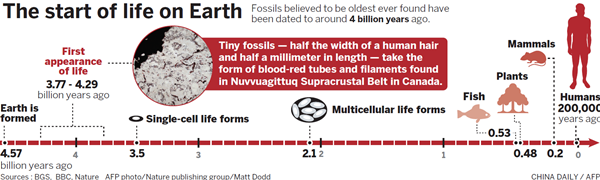
The tiny fossils — half the width of a human hair and up to half a millimeter in length — take the form of blood-red tubes and filaments formed by ocean-dwelling bacteria that fed on iron.
Locked inside white, flowerlike quartz structures known to harbor fossils, they were found along what were once warm-water vents on the ocean floor, most often in deep waters.
Such iron-rich, hydrothermal systems still exist and are home to bacteria that may be similar to those unearthed by Dodd and his colleagues.
The site of the discovery, the Nuvvuagittuq Supracrustal Belt in Canada, contains some of the oldest sedimentary rocks known on Earth.
Scientists say they formed between 3.77 and 4.29 billion years ago, and may have been the habitat for the planet’s first life-forms.
It is still not known when, or where, life on Earth began, but these deep-sea vents are seen as a good candidate.
Earth is thought to be about 4.57 billion years old, scientists said.
AFP