Picturing the changes among China's last gun tribe
 |
|
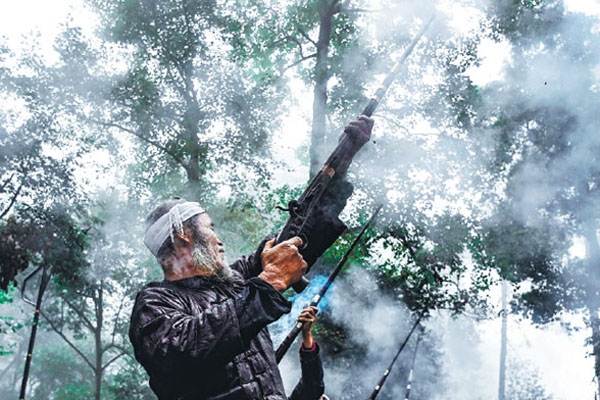
A villager fires his gun to welcome visitors as part of a show held in the village. |
Photographer has captured almost three decades of development in a once remote village where firearms are key
Kuang Huimin, from Hengshan, Hunan province, is a documentary photographer who focuses on topics such as environmental protection and social change.
Since 1989, the 52-year-old has been visiting a village in Southwest China's Guizhou province, where he has taken more than 80,000 photo for his book Changes in Biasha.
The 2,500-plus inhabitants of Biasha, 7.5 kilometers from Congjiang, the county seat, are of the Miao ethnic group and are known as China's last gun tribe.
For hundreds of years, they have held on to their unique traditions - using guns in ceremonies and to practice their marksmanship.
"Bia" means a "place with lush trees and grass" in the Miao language.
During the past 27 years, Kuang has traveled back and forth to Biasha more than 40 times, staying there for between seven and 15 days.
Before 2005, he stayed in villagers' homes, but now uses guesthouses. "The villagers were all very nice to me, but I didn't want to bother them all the time," he said.
With the development of tourism, more guesthouses were built. "It is much more convenient for travelers and photographers like me," he added.
Biasha has been transformed from a quiet, tranquil village into a well-known tourist spot, and the rapid rate of change has been the subject of many of Kuang's photos.
He believes that Biasha is in the grip of a generation gap: "The elders still preserve the traditional lifestyles. I've asked some older men how they feel about the changes in Biasha, and they told me they had nothing to do with them."
The younger generation, meanwhile, has been influenced by modernization. Since 2004, an increasing number of young people have moved away to become migrant workers in large cities. "Sometimes I have seen them getting together and chatting animatedly about their experiences and stories," Kuang said.
When he had dinner with his family during Spring Festival in 2009, Wu Jie, a young man from Biasha, told his brothers that the biggest benefit of migrating was learning to compose music and sing at a music training institute. Kuang captured the scene.
He has also noticed that married villagers would rather live by working the land at home, especially if they have more than two children to care for. In 1998, Gun Lashui went to work in Guangzhou, Guangdong province. He came home to get married in 2002 and has never set foot outside Biasha since.
It was once a tradition in Biasha that when girls married outsiders they were not allowed to return home. But now things are different. Kuang noticed that a girl who married a man in Wenzhou, Zhejiang province, came back to see her family: "She returned with a refrigerator and a color television. The economic condition of her family was totally changed."
The Lusheng Festival - the most important celebration among people of the Miao ethnic group - is celebrated on the 19th day of the eleventh month of the lunar calendar. The villagers dress up for the day, worshipping their ancestors in traditional ways, and the men play the lusheng, a type of reed pipe, and tell stories and the history of Biasha.
"Now, villagers play the lusheng for visitors every day, and some of the women have even joined the performance team," Kuang said.
He planned to conclude his project in 2014, but he found it difficult: "Biasha is changing all the time. Every time I went there, I saw new things."
Last year, the villagers began to build a reservoir in Zaizhang.
"Just within a few months, the wooden bridges and trees that I had photographed were gone. The changes have occurred too quickly, really," he said.
Kuang considers Biasha to be a microcosm of Chinese villages. "It is more than just a small village. It reflects a picture of the whole society. My photography project about Biasha may never end."
Chai Pingyan contributed to this story.
|
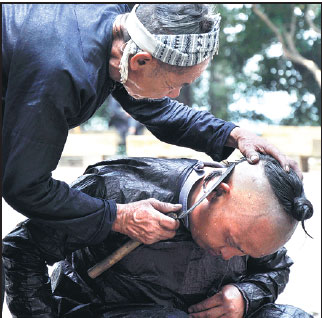
A villager shows visitors the traditional method of cutting hair in Biasha village, Guizhou province.Photos By Kuang Huimin / For China Daily |