Severe smog may become thing of the past by 2030
China aims to eradicate severe smog by 2030, but more time and regulations are needed to make constant blue skies a reality, scientists from the Chinese Academy of Sciences said on Wednesday.
Coal-burning, car exhaust fumes and emissions from industrial production are the main causes of smog, therefore, implementing stricter laws on pollutant emissions, improving fuel efficiency and reshaping China's energy structure are crucial to improving the country's overall air quality, the scientists said at a smog research conference in Beijing.
Since 2013, the number of days with severe smog - defined as days when the air quality index is 300 or higher - has gradually decreased, said He Hong, a researcher at the academy's Institute of Urban Environment. China's national air quality has also improved, especially in Beijing and its surrounding regions, he said.
However, winter smog in central and eastern regions remains a significant issue, and Beijing's winter smog in 2016 showed no improvement compared to the previous three years, He said.
He said that secondary pollutants, such as ozone, sulfates and nitrates, are now the main contributors to smog in central and eastern regions, accounting for more than 60 percent of the region's PM2.5 - fine particulates that are harmful.
"We still do not know the mechanism by which these pollutants form, but our tests show that they are extremely potent in creating smog," He added.
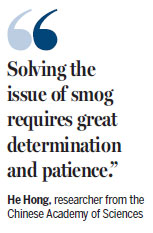
Moreover, in areas surrounding Beijing, a lack of wind and surrounding mountains make it hard for smog to disperse, which "could reduce our environmental capacity and neutralize our anti-smog efforts," He said. "Solving the issue of smog requires great determination and patience."
What makes secondary pollutants so hard to regulate is that they are not emitted directly into the air, but synthesized through complex chemical reactions from primary pollutants released by vehicles and factories, said Chen Yunfa, a researcher at the academy's Institute of Process Engineering.
China has made significant progress in reducing primary pollutants such as gaseous oxides and particulates in recent years, but more research and regulations on secondary pollutants are required, Chen said.