Industry drive in progress for Beijing to ease population glut
 |
|
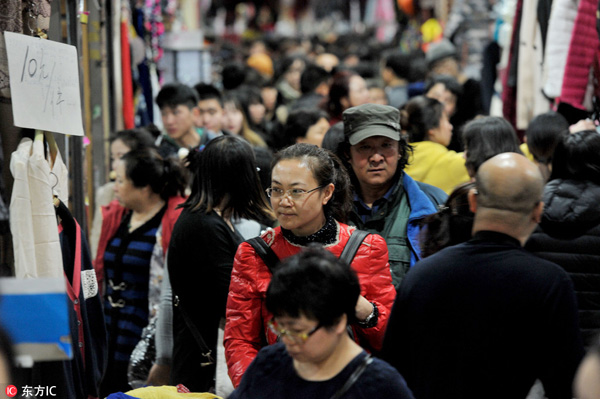
People visit the Beijing Zoo wholesale market on Dec 30, 2015. [Photo/IC] |
BEIJING - Zhang Yue has been a wholesaler in Beijing for nearly a decade. But if he wants to continue his business, he now has to resettle in a strange, new place.
Zhang, 40, from eastern China's Anhui Province, started his clothing wholesale chain at the Beijing Zoo wholesale market 10 years ago. Starting last year, major wholesale markets in Beijing have been relocated one after another.
"Many wholesalers and I have visited Yongqing County for several times, and, probably, my family are going to move there next year," Zhang said.
Yongqing county, an hour's drive south of Beijing, is located in neighboring Hebei province. With an investment of 60 billion yuan (8.7 billion U.S. dollars), a new market is being built there to provide new work and homes to those displaced from Beijing.
RELOCATION AND POPULATION
"Some wholesalers have already moved to Baigou, Baoding city in Hebei, a two-hour drive from Beijing," Zhang said.
According to the latest municipal development plan, Beijing plans to cap its population at 23 million by 2020, reducing the population in six core districts to 15 percent lower than 2014 levels.
Non-capital functions, including manufacturing, logistics, wholesale markets, and partial functions of public service, are gradually being phased out to ease Beijing's "urban disease," the municipal government said in July last year.
Built in the mid-1980s, Beijing Zoo wholesale market became a hit with young people wanting to look fashionable on a budget.
The relocation of the market started in 2014 and is expected to be completed by the end of the year.
So far, over 300 wholesale markets have closed or relocated in the past three years in an effort to reduce traffic congestion and curtail population density in Beijing.
"As businesses are moved away, so are the people who work in them," said Ren Luyan, director at the Beijing Municipal Commission of Development and Reform.
According to the commission, the annual growth of Beijing's population in 2014 and 2015 decreased by 231,000, down 1.3 percentage points, compared with the former three years of the 12th Five-year Plan (2011-2015) period.
Beijing was home to 21.7 million permanent residents by the end of 2015, 189,000 more people than 2014, registering a 0.9 percentage point decrease in its growth rate.
The dual decrease of Beijing's population net increase and growth rate has shown some progress in the city's population control, an official with the commission said.
"I will try my luck in Yongqing. If my business does not work there, I will consider switching to another line of work, or going back to my hometown."
According to Zhang, the new site in Yongqing is not as advantageous as the Beijing Zoo market and is desolate for now.
"But I want to continue my clothing wholesale business, which is what I am familiar with. I hope the government can do more to help us attract customers in Yongqing," Zhang said.


- City solicits private investors for PPP projects
- Industry drive in progress for Beijing to ease population glut
- Seniors go to day-care nursing home every day
- Xi says central govt fully acknowledges work of HKSAR chief executive, govt
- Free use of public library system for foreign residents in SW China