Space food: Pie in the sky or a taste of the future?
|
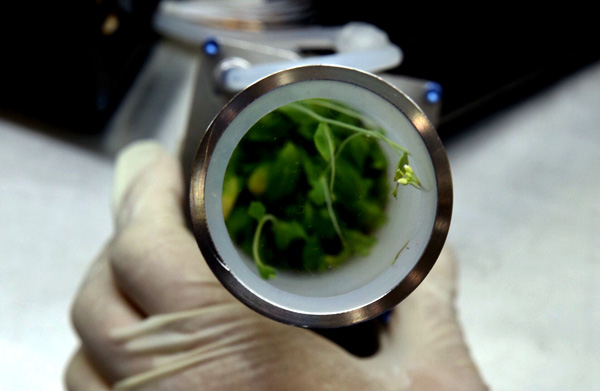
A sample of the thale cress that returned to Earth along with the astronauts in the Shenzhou XI reentry capsule.Jin Liwang / Xinhua |
In the science fiction movie The Martian, the astronaut stranded on the Red Planet lives for more than 500 days on potatoes he has grown while awaiting rescue.
The scenario in the film may become reality someday, but right now ambitions are pitched a little lower. After all, humans have yet to set foot on Mars and so far, astronauts have only tasted extraterrestrial food in the form of lettuce grown on the International Space Station.
An experiment is now underway to grow rice and thale cress aboard Tiangong II, China's latest space lab, which was launched in September.
Scientists hope the plants will go through their whole cycle, from seed to seed, and are eager to discover whether plants in space - where there is no distinction between up and down, day and night, or seasons - still blossom according to an Earth-based cycle and yield the same seeds.
"We want to study the growth rhythm and the flowering of plants in conditions of microgravity," said Zheng Huiqiong, chief scientist in charge of plant research on Tiangong II and a researcher at the Institute of Plant Physiology and Ecology of the Shanghai Institutes for Biological Sciences.
"So far, the plants on Tiangong II have been growing well. Some thale cress is blooming and the rice is about 10 centimeters tall," Zheng said.
When the two astronauts who flew the Shenzhou XI spacecraft to the space lab on Oct 17 returned to Earth at the weekend, they brought back samples of the cress, which are expected to yield seeds in space, according to Zheng.
The rice experiment will continue on Tiangong II for about six months. "This is China's longest plant-growing experiment in space," said Zhang Tao, a researcher with the Shanghai Institute of Technical Physics, who is in charge of developing the plant incubator on Tiangong II.
"Unlike similar experiments on the International Space Station, which are usually conducted by astronauts or biologists on board, we designed the incubator so scientists on Earth can remotely control the lighting, temperature, humidity and volume of the nutrient solution during the experiment," he added.
Crop cultivation will be a key task if bases are to be established on the Moon or on Mars, but so far, there is no successful example of plants being grown in the type of totally enclosed environment that would be required on other planets.