|
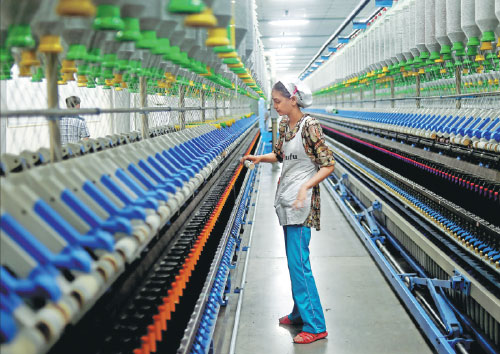
An employee of Huafu Top Dyed Melange Yarn works at the company's plant in Aksu, the Xinjiang autonomous region. Jin Liangkuai / Xinhua |
1 million textile jobs to be created by 2023 in the autonomous region
The Youngor cotton spinning factory is one of the biggest employers in Aksu, an agricultural town on the edge of the Taklamakan desert in the Xinjiang Uygur autonomous region.
Youngor, one of China's largest shirtmakers, opened the plant in 2011 to be closer to the main cotton-growing region in the Xinjiang region. Soon it will be joined by others: China wants to create 1 million textile jobs in Xinjiang by 2023.
According to the regional government's 13th Five-Year Plan (2016-2020), Xinjiang will become a key hub for textile production. It will also extend the industry chain from cotton spinning to making garments. By 2020, Xinjiang is expected to produce about 500 million garments annually and create more than 600,000 jobs.
Aksu, in southern Xinjiang, will become one of three textile cities in the region, the plan for 2016-2010 said. It also will encourage residents to start their own textile workshops to make traditional ethnic clothing and carpets.
Xinjiang fits into Beijing's larger vision of shifting labor-intensive industries such as textiles out of the Pearl River Delta and into the interior. China is putting less value on being "the world's workshop" amid labor shortages and competitive pressures from Southeast Asia.
The textile hub is also a key initiative in President Xi Jinping's Belt and Road Initiative, which seeks to link development from western China to Central Asia and onward to Europe.
"We must promote employment as a permanent cure to maintain social stability and achieve long-lasting peace, and particularly solve the unemployment problem for people in southern Xinjiang," a 2014 official document stated, outlining a massive expansion of Xinjiang's textile industry.
Xinjiang, which is home to more than half of China's Muslims, has always been China's front line on religious extremism that is blamed for terrorist attacks in the region in recent years. The regional government believes employment and better education can help young people stay away from such extremism.
Migrating to cities
Almost all of the 520 employees at the Youngor factory are from the Uygur ethnic group. The average factory floor salary is around 3,000 yuan ($456) a month, and comes with food and lodging. That compares to roughly 4,000 yuan for textile workers in the southern China factory belt.
"There are still a lot of people to come out of (Xinjiang's) countryside," said Xu Zhiwu, general manager at Youngor's Aksu factory, referring to government data that show 2.6 million rural residents sought work in Xinjiang's cities in 2014.
Xinjiang Youngor Cotton Spinning, a unit of Youngor Group, is planning to expand its factory, built among apple orchards on Aksu's outskirts, Xu said.
Yarn maker Huafu Top Dyed Melange Yarn is already at work on a 5 billion yuan plant outside Aksu. And Texhong Textile Group, one of China's top spinners, is targeting a 1-million spindle project in the region.
"The scale of the project has to be big to ask for more favorable policy support from municipal governments," Texhong reported in a stock exchange statement, referring to subsidies Beijing offers to lure firms to the region.


Copyright 1995 - . All rights reserved. The content (including but not limited to text, photo, multimedia information, etc) published in this site belongs to China Daily Information Co (CDIC). Without written authorization from CDIC, such content shall not be republished or used in any form. Note: Browsers with 1024*768 or higher resolution are suggested for this site.
License for publishing multimedia online 0108263 Registration Number: 130349