China has finalized a plan setting tough fuel standards for large ships in an effort to slash marine emissions, the Ministry of Transport said on Monday.
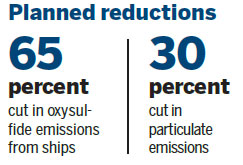
When fully implemented, the coordinated effort will reduce oxysulfide emissions from ships by 65 percent and particulate emissions by 30 percent by 2020, compared with current emissions, Li Qingping, a senior official at the ministry's Maritime Safety Administration, told a news conference in Beijing.
Three emission control zones have been established in China's Pearl River and Yangtze River deltas and the Bohai Sea area, and the plan will first be implemented in these zones. Eleven ports in the zones, including Shanghai's and Tianjin's ports, have become core ports under stricter monitoring.
From April 1, ships must use fuel with sulphur content of lower than or equal to 0.5 percent during their berth in core ports in the Yangtze River delta control zone, said Li, adding that from Jan 1 next year, ships in all core ports must follow the same standard.
Beginning on Jan 1, 2018, the rule will expand to all ports in the three control zones. Starting on Jan 1, 2019, all ships will have to follow the rule once they enter control zones.
Stricter rules
Around Dec 31, 2019, China will introduce stricter rules on marine emissions, including reducing the standard of sulphur content to 0.1 percent and expanding the control zone, Li said.
He said ships with foreign flags also will have to follow the rule, adding that the ministry is working on an English-language document on the policy.
"There are enormous health and environmental consequences that come from marine emissions, affecting both port cities and inland areas. The regulation will lead to significant air quality improvements throughout the country," said Li.
According to the ministry's data, marine emissions account for 8 to 10 percent of Shanghai's PM2.5, which is airborne particulate matter smaller than 2.5 microns in diameter that can penetrate the lungs and harm health.
According to the Ministry of Environmental Protection, marine oxysulfide emissions in 2013 accounted for 8.4 percent of total oxysulfide emissions, and oxynitride emissions accounted for 11.3 percent of the total. Marine pollution has the largest impact on port cities, but it also affects cities along rivers.
According to the Ministry of Transport's data from 2013, China has more than 170,000 transport ships, with net deadweight of 240 million metric tons.


Copyright 1995 - . All rights reserved. The content (including but not limited to text, photo, multimedia information, etc) published in this site belongs to China Daily Information Co (CDIC). Without written authorization from CDIC, such content shall not be republished or used in any form. Note: Browsers with 1024*768 or higher resolution are suggested for this site.
License for publishing multimedia online 0108263 Registration Number: 130349