 |
|
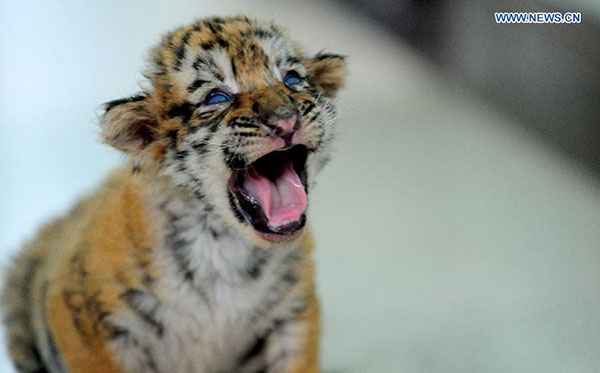
A Siberian tiger cub waits for feeding at a tiger park in Shenyang, capital of Northeast China's Liaoning province, June 22, 2015.[Photo/Xinhua] |
Officials in northeast China are planning a resident resettlement and afforestation project to double the size of a key migration corridor for wild Siberian tigers and Amur leopards that has become overpopulated with the endangered cats.
Chinese and Russian conservationists estimate their protection has taken the number of tigers and leopards in Hunchun of Jilin Province and a nature park over the border in Russia to 35 and 70. The stretch of land used by the animals to move between the zones is currently 4,000 square km, and they are in close proximity to Chinese residents and their cattle.
More than 8,000 households will be resettled over the next five years in and near Hunchun to make way for the afforestation, said Lan Hongliang, head of the Jilin forestry department, at a seminar at Beijing Normal University (BNU) on Wednesday.
The government has earmarked 4 billion yuan (608 million yuan) to offer farmers subsidized housing in urban areas and help them find new jobs, according to Fang Yan, a rural economy official with the National Development and Reform Commission, China's planning body.
Ge Jianping, BNU vice president and an academic who has studied wild Siberian tigers and Amur leopards for decades, said at the seminar that their numbers around Hunchun have reached three times what the area can support. He said the overcrowding could cause a population crash because of pressure on resources, undoing conservationists' good work thus far.
"If we fail to provide enough space for their habitat expansion, China will miss the perfect chance for the two species' rehabilitation," Ge said.
The problem of big cats brushing up against dwellings is broader than the obvious threat to their human inhabitants, most of whom are herders. Their cattle threaten ungulate wild animals as they consume the same grass, and the decline of ungulates, as prey for carnivores, in turn threatens the survival of tigers and leopards.
"The relocation is aimed at reducing the human impact on the corridor for the tigers and leopards, especially from poaching and grazing, which are the biggest threats for both the endangered species and ungulate animals," said Lan.
He also called on the government to encourage development of green industries such as bee keeping and eco-tourism, to balance environmental and economical concerns.
"The relocated farmers must have jobs after they move to the city," Lan said.
Siberian tigers mainly live in east Russia, northeast China and northern parts of the Korean Peninsula. About 500 are believed to survive in the wild.
Amur leopards are classified as critically endangered. In 2007, the International Union for Conservation of Nature concluded that Amur leopards were extinct in China and only 19 to 26 survived in Russia.


Copyright 1995 - . All rights reserved. The content (including but not limited to text, photo, multimedia information, etc) published in this site belongs to China Daily Information Co (CDIC). Without written authorization from CDIC, such content shall not be republished or used in any form. Note: Browsers with 1024*768 or higher resolution are suggested for this site.
License for publishing multimedia online 0108263 Registration Number: 130349