Rare parasitic plant last recorded in the deep south of Yunnan in the 1980s
A family of rare parasitic flowers that can match anything found in the movie Avatar recently reappeared in the rainforest of Xishuangbanna in Southwest China's Yunnan province.
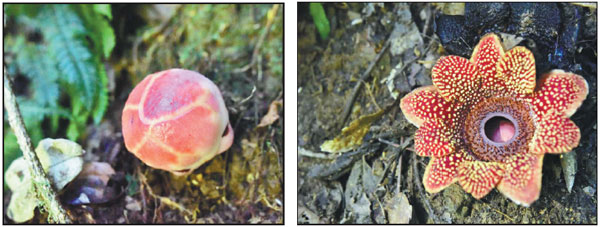
Researchers from the Xishuangbanna Tropical Botanical Garden affiliated to the Chinese Academy of Sciences uncovered two photos on a local tourist guide's WeChat messaging app in early January that showed an odd mushroom-like flower - flaming red in color - with no leaves or roots of any kind.
|
From left: A bud and a blossom of rafflesiaceae found recently in the rainforest of Xishuangbanna in Yunnan province. Photos Provided to China Daily |
Recognizing that the flowers could be rafflesiaceae, which have not been seen in China for around three decades, the researchers carried out a field investigation and found two sites where the plants were blooming in the heart of the rainforest.
"Rafflesiaceae exist only in tropical rainforests in Southeast Asia. According to our records, researchers discovered the flowers in Xishuangbanna in the 1980s, but they have not been observed since," said Liu Guangyu, a researcher at the botanical garden.
Named after British statesman Sir Thomas Stamford Raffles, who collected a specimen from the island of Sumatra in 1818, rafflesiaceae have since been recorded across modern-day Indonesia, Thailand and Malaysia.
As parasites, rafflesiaceae do not need roots to absorb water or leaves for photosynthesis, and are wholly reliant on their hosts, vines in the genus Tetrastigma, for sustenance.
Some can grow extremely large, with a diameter of more than 1 meter, making them the largest flowers on Earth.
"Earlier research conducted by Western botanists inferred that rafflesiaceae develop such big blossoms because they do not need to waste any energy absorbing nutrients - all their needs are met by the host vine, so the flowers can use resources extravagantly," Liu said.
However, the flowers found in Xishuangbanna are much smaller than their record-breaking siblings, measuring about 10 to 12 centimeters in diameter.
"We are now using cell samples taken from the flowers to carry out DNA tests so we can find out whether this is a new species or just a relative of the rafflesiaceae found elsewhere," said Tan Yunhong, a researcher specializing in plant classification at the botanical garden.
Yet this analysis could be complicated by the fact that rafflesiaceae often share some of their genes with the host plant, in a process known as horizontal gene transfer.
"We will only use the most stable genes to analyze the specimens' genetic relationship with other parasitic plants, but we will not know how horizontal gene transfer will influence the result until we finish gene sequencing and start the analysis," Tan said.
Whatever the outcome, this latest study into rafflesiaceae is almost certain to uncover something new about the mysterious family of plants, as so little is known about them.
"We do not know how they appear, grow or are fertilized. Maybe after a while they will disappear again, so we have to carry out our research quickly while the flowers are still there," Liu said.
All known species of rafflesiaceae have been classified as endangered species by the International Union for Conservation of Nature, a global environmental NGO.


Copyright 1995 - . All rights reserved. The content (including but not limited to text, photo, multimedia information, etc) published in this site belongs to China Daily Information Co (CDIC). Without written authorization from CDIC, such content shall not be republished or used in any form. Note: Browsers with 1024*768 or higher resolution are suggested for this site.
License for publishing multimedia online 0108263 Registration Number: 130349