As the government debates ways of injecting greater momentum into the Chinese economy, the recent deliberations of a committee may point the way forward, as Zheng Yangpeng reports.
"Supply-side reform" has been a buzz-phrase since early November, when President Xi Jinping mentioned it at a top economic meeting. Overnight, nearly everybody in Beijing's policy circles began talking about it, as if the phrase had magical powers.
So what exactly is supply-side reform? Chinese economists first raised the concept when economic growth began to slow after 2012, arguing that policymakers should pivot toward the supply-side model, as the antithesis of the long-favored Keynesian demand-side management. Essentially, supply-side economics is predicated on the belief that lowering corporate taxes will encourage investment in industry and, in turn, spur growth.
However, the debate was largely confined to economic circles until it was picked up by the top leadership and given policy significance.
To understand the meaning of supply-side reform, it's important to know what proponents of this approach oppose.
In many cases, advocates of the supply-side theory disagree about the exact priorities of such reform, but are surprisingly unanimous about what policymakers should not do. They do not propose the outright abandonment of the Keynesian stimulus, but are strongly against using it repeatedly and indiscriminately as a once-and-for-all way of pulling the economy out of its malaise.
Paradigm shift
Addiction to the short-sighted prescriptions of demand-side policies, such as interest rate cuts, only exacerbates the chronic misallocation of resources in the economy while delaying the chance to implement reforms that could improve the long-term potential growth rate, experts say.
The fact that the Chinese economy continued to grind on, despite rounds of mini-stimulus - including six interest rate cuts and fiscal spending stimuli - vindicated the arguments of supply-side supporters, leading the top leadership to adopt it as an official paradigm shift.
"The most important thing it does is silence those calling for demand-led growth and indicates that China will have to knuckle down to a period of genuine, if painful, restructuring," said the research arm of Haitong Securities in a note to investors
To Western observers, supply-side reform is reminiscent of Reaganomics and Thatcherism - sweeping economic policies in the 1980s that helped the two countries emerge from crippling periods of "stagflation", which is characterized as slowing growth coupled with high inflation.
However, analysts said the staples of the two - tax cuts, in the case of Reaganomics and the privatization of State-owned enterprises for Thatcherism - are unlikely to be the main bones of China's supply-side reform.
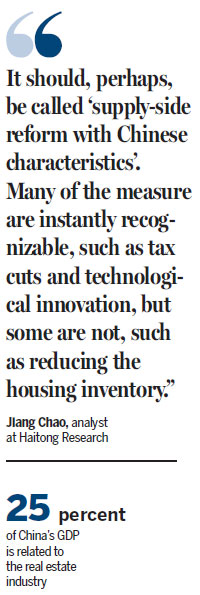
"It should, perhaps, be called 'supply-side reform with Chinese characteristics'. Many of the measures are instantly recognizable, such as tax cuts and technological innovation, but some are not, such as reducing the housing inventory," said Jiang Chao, an analyst at Haitong Research.


Copyright 1995 - . All rights reserved. The content (including but not limited to text, photo, multimedia information, etc) published in this site belongs to China Daily Information Co (CDIC). Without written authorization from CDIC, such content shall not be republished or used in any form. Note: Browsers with 1024*768 or higher resolution are suggested for this site.
License for publishing multimedia online 0108263 Registration Number: 130349