 |
|
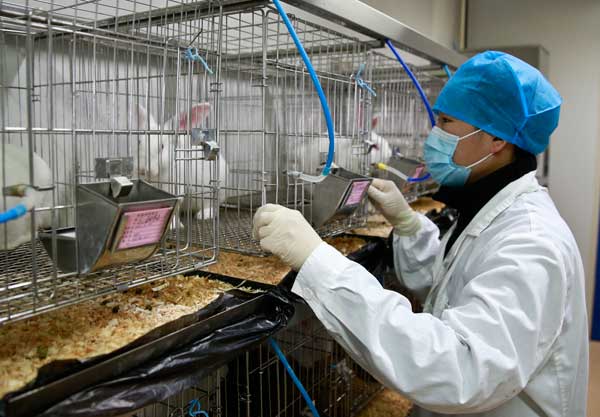
Rabbits are raised at the institute in an environment where temperature, humidity and air pressure must all meet national standards. PHOTOS BY FENG YONGBIN / CHINA DAILY AND LIU DAWEI / XINHUA |
The issue stirred public outrage in December in the wake of media reports that more than 10 dogs had been abandoned in a building at the Xi'an Medical University, in Xi'an, Shaanxi province. The dogs, which all bore scars from laboratory experiments, had been left to die.
In response, the university pledged to establish a special committee to intensify the management of laboratory animals and improve training for faculties and students. Several officials were also subjected to a range of punishments, including suspension from duty.
According to a statement by CALAS, the case showed that the university's researchers and students lacked sufficient know-ledge of the laws and regulations related to laboratory animals.
"We suggest all producers and users of laboratory animals provide strict training for their employees, improve management systems and strictly follow the national regulations," the statement said.
Sun said the case was an isolated incident, and pointed out that the abuse of laboratory animals has happened in many other countries.
"In general, most certified institutions in China adhere strictly to the welfare management rules for laboratory animals," he said.
Yue, from the institutes for food and drug control, said some internationally accepted practices and concepts, such as the "3Rs" — replacing and reducing the number of animals used in experiments, and refining the procedures to make them less painful — have been widely adopted across the country.
Huang Song, director of the Biological Resources Center at the National Institute of Biological Sciences in Beijing, said the institute's scientists must obtain approval from the Institutional Animal Care and Use Committee, comprising scientists from the institute and other establishments, before conducting experiments on live animals.
The environment for raising laboratory animals is carefully controlled to ensure better-quality research, so the temperature, humidity and even the air pressure in the hermetically sealed environments meet all national standards.
Laboratory animals possess specific characteristics that make them suitable for experiments that eventually benefit humans, Huang said.
For example, mice share many genetic similarities with humans, are easy to breed and have high rates of reproduction, making them the most commonly used mammals in laboratory experiments, he said.
Some animals, such as chimpanzees, share even greater similarities and live much longer than mice, so they can be used to test the long-term effects and potential damage of medicinal drugs, he said. However, their use is limited, partly because of the high cost of raising them, but also because their similarity to humans means researchers quickly develop emotional attachments to them, he added.


Copyright 1995 - . All rights reserved. The content (including but not limited to text, photo, multimedia information, etc) published in this site belongs to China Daily Information Co (CDIC). Without written authorization from CDIC, such content shall not be republished or used in any form. Note: Browsers with 1024*768 or higher resolution are suggested for this site.
License for publishing multimedia online 0108263 Registration Number: 130349