 |
|
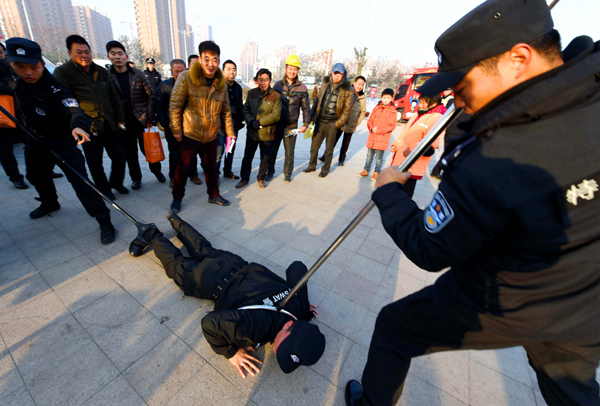
Policemen hold a "terrorist" captive during a drill in Bozhou, Anhui province, Jan 9, 2014. [Photo by Liu Qinli/China Daily] |
Cybersecurity concerns
Liu, the criminal expert, was initially concerned that an article requiring providers of Internet and telecommunication services to build "backdoors" into their services to allow access for government surveillance could severely damage China's international image. However, the article was amended during the second reading to stipulate "a strict approval procedure" for surveillance of this kind.
"You won't find similar articles in anti-terrorist legislation in the US or European countries," he said. "China has frequently expressed concerns about the US conducting online surveillance, but now we are doing exactly the same thing."
He was also worried that the security issue could spark objections from foreign Internet users and the international partners of Chinese Internet and telecommunications companies.
Liu said the government would find it impossible to monitor the massive amounts of data online, and suggested amending the article to require Internet and telecommunication service providers to cooperate with the anti-terrorism forces in monitoring possible online terrorist activities when necessary.
Many of those who have carried out deadly attacks in China have watched or listened to online video or audio files containing extremist ideological content, but the material is produced or uploaded outside the country, according to Zhang Xinfeng, director of the Regional Anti-terrorist Structure Executive Committee of the Shanghai Cooperation Organization, a Eurasian political, economic and military body founded in Shanghai in 2001 by the leaders of China, Kazakhstan, Kyrgyzstan, Russia, Tajikistan and Uzbekistan.
In September, President Xi urged the organization, which has its headquarters in Tashkent, the capital of Uzbekistan, to increase its focus on the two major security issues in Xinjiang: religious extremism and cyberterrorism.
As one of the most-discussed and debated pieces of modern legislation, the new law will significantly strengthen China's anti-terrorism mechanism by improving coordination among a range of organizations, experts said.
The law needs to further clarify the role of each anti-terrorism department and formulate procedures to deal with attacks, such as correctly identifying the circumstances in which firearms can be used, Qi said.
According to Mei Jianming, director of the Counterterrorism Research Center at the People's Public Security University of China: "If armed terrorist suspects threaten to kill people or cause great damage to property, the law would allow a range of different units to take immediate action to control the situation and shoot at the suspects to minimize the number of casualties."
Copyright 1995 - 2015 . All rights reserved. The content (including but not limited to text, photo, multimedia information, etc) published in this site belongs to China Daily Information Co (CDIC). Without written authorization from CDIC, such content shall not be republished or used in any form. Note: Browsers with 1024*768 or higher resolution are suggested for this site.
License for publishing multimedia online 0108263 Registration Number: 130349