 |
|
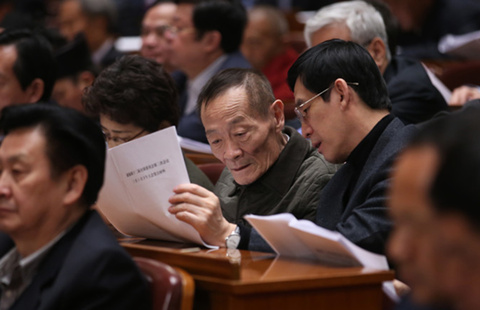
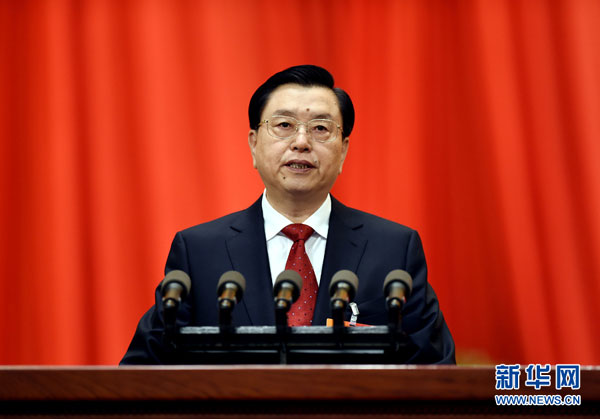
China's top legislator Zhang Dejiang delivers a work report at a a plenary meeting of theNational People's Congress' annual session in Beijing March 8, 2014.[Photo/Xinhua] |
Editor's note: Caught unprepared by the abruptly announced policies to restrict house and car purchases or to control the number of cars on road in your city? Sometimes confused by the conflicting rules issued by different departments? These or similar situations will probably not happen because of the Legislation Law that is being revised. On Sunday's afternoon, the draft of a revised version of the law was handed over to the NPC for discussion and is scheduled for a vote on Mar 15.
The Legislation Law is a basic set of rules, with its judicial significance only after the Constitution. Although it is so high-profile a law, it is related to the life of everyone: it can make the lawmaking process more scientific and democratic, standardize and restrain governments' administration, and make people feel happier. Here comes the list of changes the revision will bring to our lives.
More difficult to levy tax
[Problem] The oil consumption tax rose many times from the end of last year to the beginning of 2015. The Supreme People Court promulgated a judicial interpretation for the Marriage Law in 2011 to allow regional authorities to charge "tax on adding name to ownership certificate". Similar arbitrary rules are too numerous to list and our money are taken away without much we can do. But how could the tax levying be so casual?
[Revised law] The draft of the law's revised version makes it an independent clause about the power of determining tax, regulating that it has to be put into laws to start a new tax, end an old one or manage the collection of tax, namely "tax determined by law".
[Interpretation] Peking University professor Jiang Ming'an: "Tax determined by law" is one of the principles of a country ruled by law, which means tax levying could only be determined by the NPC or its standing committee. The administrative regulations, regional regulations or rules will no longer be allowed to serve as the support to a new tax or manage the existing ones. At the moment, however, most of the taxes in our country are supported by regulations or even, instead of laws. So the Legislation Law revision is trying to resolve this problem. It has been made clear at the ongoing annual "two sessions" that the goal of determining tax by law will be totally achieved by 2020.
China University of Political science and Law's lifetime professor Ying Songnian: Out of the 18 taxes levied in China, only the personal income tax, corporate income tax, and vehicle and vessel tax are supported by laws made by NPC and its standing committee. All the other 15 are levied on the back of temporary regulations made by the State Council. The Legislation Law will make it clear in the future that only the nation's top legislature body can determine what tax and how to levy, as well as who and how much will be charged for tax. If the draft is approved, every new tax has to undergo lawmaking process by NPC or its standing committee.
Copyright 1995 - 2015 . All rights reserved. The content (including but not limited to text, photo, multimedia information, etc) published in this site belongs to China Daily Information Co (CDIC). Without written authorization from CDIC, such content shall not be republished or used in any form. Note: Browsers with 1024*768 or higher resolution are suggested for this site.
License for publishing multimedia online 0108263 Registration Number: 130349