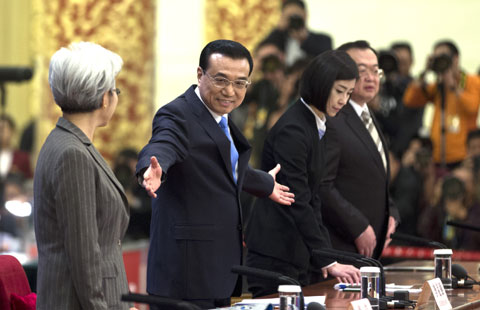
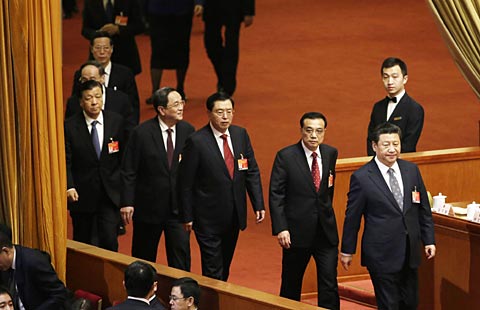
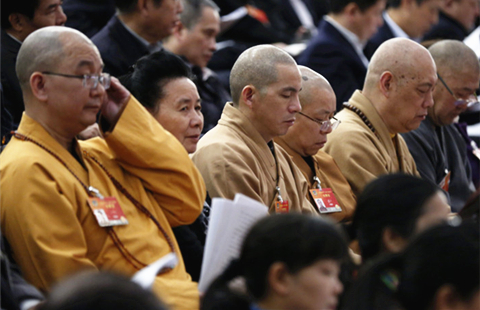
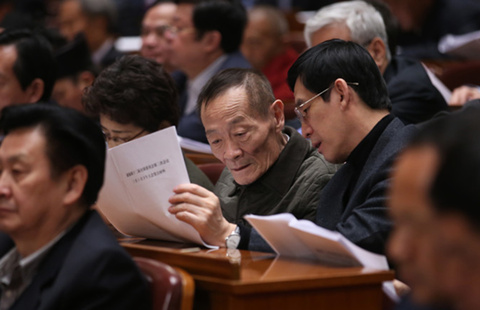
China is poised to take a giant stride in bolstering the rule of law as the country's top legislature considers what is expected to be the final reading of a draft amendment to the Law on Legislation.
"The revisions are expected to improve the legislative system, raise the quality and efficiency of legislation, maintain the unity of the legal system of the country, establish a sound system of laws, modernize China's governance system and capacity for governance and build the country under a socialist rule of law," said Li Jianguo, vice-chairman of the Standing Committee of the National People's Congress, in explaining the draft to deputies.
Proposed revisions to the law were announced at the annual plenary session of the NPC on Sunday. Nearly 3,000 deputies will discuss the revisions and vote on March 15.
The Law on Legislation regulates the process of making laws and regulations at both national and regional levels and codifies the legislative authority of people's congresses and government organs. The law has served as the cornerstone of the lawmaking process for almost 15 years.
The revisions aim to standardize the process under which laws are made in order to safeguard people's rights. Among other things, they set out the legislative authority on taxation, gradually give legislative authority to all 284 cities with administrive districts and stipulate that all legal burdens imposed on people must be laid out in written law.
The revisions underwent a first reading before the Standing Committee in August and a second reading in December. After deputies' deliberations in the third reading this week, the draft is expected to be endorsed, provided there are no serious disagreements before the matter is put to a vote.
Currently, taxation is not adequately addressed in law, said Liu Zuo, deputy head of the Institute of Financial and Tax Law Studies in Beijing. Of China's 18 existing items of taxation, only three-individual income tax, corporate income tax and vehicle and vessel tax-are codified in written laws, while others are based on regulations or rules made by local government organs.
Similar practices also exist in some cities, limiting the rights of individuals to purchase property and restricting traffic access to roads based purely on local policies instead of written laws.
The draft amendment allows local governments to formulate regulations that increase the legal obligations of citizens "due to the urgent needs of government administration", but it requires governments to initiate proposals for laws in the people's congresses or their standing committees at the same level, and to write such regulations into laws when they have been in force for two years.
Gu Shengzu, an NPC Standing Committee member, said only good laws lead to good governance. The role of the Law on Legislation is to produce good laws, Gu said.
The draft amendment underscores the principle that the people's congresses have a right to legislate, a change that removes ambiguity between the legislative authority and the government's administrative authority.
Related Stories
Copyright 1995 - 2015 . All rights reserved. The content (including but not limited to text, photo, multimedia information, etc) published in this site belongs to China Daily Information Co (CDIC). Without written authorization from CDIC, such content shall not be republished or used in any form. Note: Browsers with 1024*768 or higher resolution are suggested for this site.
License for publishing multimedia online 0108263 Registration Number: 130349