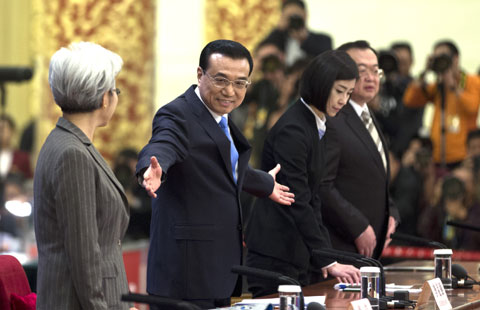
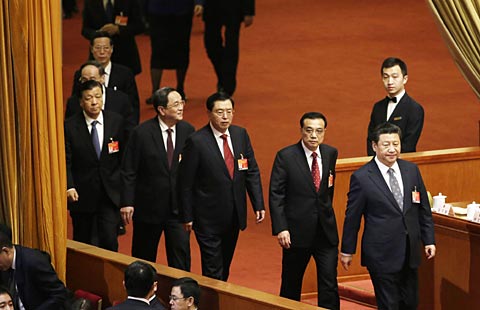
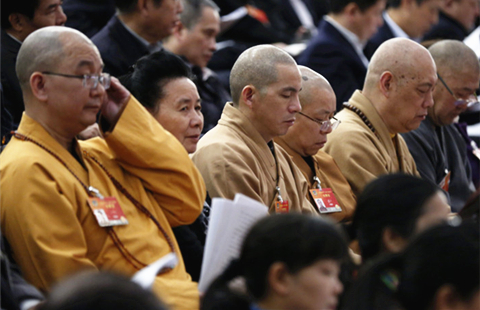
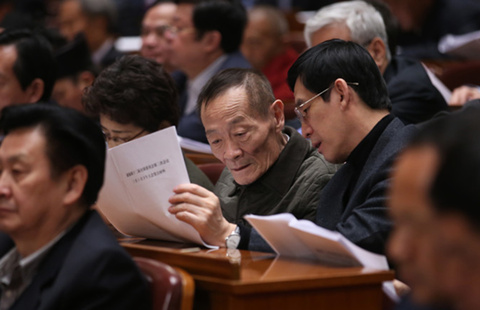
BEIJING - The Third Session of the 12th National Committee of the Chinese People's Political Consultative Conference (CPPCC) is to open in Beijing on Tuesday.
The CPPCC serves as a key mechanism for multi-party cooperation and political consultation under the leadership of the Communist Party of China (CPC), and a major manifestation of socialist democracy.
At present, the CPPCC consists of representatives of the CPC and non-Communist parties, personages without party affiliation, and representatives of people's organizations, ethnic minorities and various social strata.
It also has the representation of compatriots of the Hong Kong Special Administrative Region, Macao Special Administrative Region and Taiwan, returned overseas Chinese, and specially invited people.
Most of the CPPCC members are experienced political figures, social celebrities, and experts and scholars specializing in various fields.
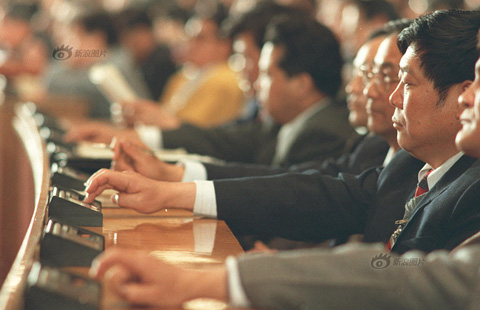
The main functions of the CPPCC are to conduct political consultation, exercise democratic supervision and participate in the discussion and the handling of state affairs. Political consultation covers major principles and policies proposed by the central and local governments and matters of importance concerning political, economic, cultural and social affairs.
Democratic supervision means to exercise, by means of offering suggestion and criticism, supervision over the implementation of the Constitution, other laws, regulations and major policies, and over the work of government agencies and their functionaries.
Participation in discussing and handling state affairs means to organize CPPCC members of various parties, people's organizations, people of various ethnic minorities and other social groups to take part in the country's political, economic, cultural and social activities in whatever way they think fit.
The current CPPCC should be distinguished from the political body bearing the same name but established in 1946 following the victory of the War of Resistance Against Japanese Aggression upon the decision taken by the CPC and the Kuomintang in their negotiations in Chongqing as part of the preparations for forming a new government.
But hardly before the old CPPCC began to function was it disintegrated in November of the same year when the Kuomintang betrayed the resolutions of the conference and unilaterally proclaimed the convocation of a "National Assembly."
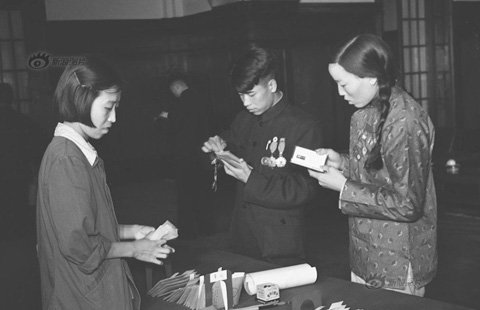
The first session of the new CPPCC was held in Beijing in September 1949. Authorized to perform the functions of the supreme organ of power, the session adopted a "Common Program" which bore the nature of a temporary constitution, proclaimed the founding of the People's Republic of China, elected a council of the central people's government with Mao Zedong as the chairman, and elected the First National Committee of the CPPCC.
The CPPCC ceased to act as the supreme organ of power in September 1954 when the National People's Congress was convened. Instead, it shifted its functions as China's patriotic united front organization for its broad representation. It has ever since played a vital role in the country's political, economic, cultural and social affairs and in international exchanges.
The CPPCC has a National Committee and local committees. With a functioning term of five years, the CPPCC committees hold annual sessions.
Copyright 1995 - 2015 . All rights reserved. The content (including but not limited to text, photo, multimedia information, etc) published in this site belongs to China Daily Information Co (CDIC). Without written authorization from CDIC, such content shall not be republished or used in any form. Note: Browsers with 1024*768 or higher resolution are suggested for this site.
License for publishing multimedia online 0108263 Registration Number: 130349