 |
|
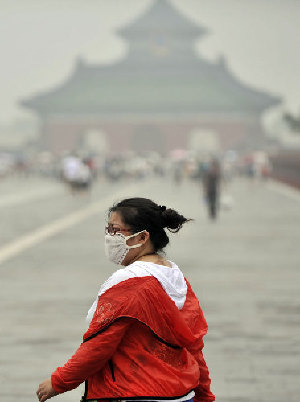
A mask-wearing woman walks in the Temple of Heaven during an extremely smoggy day in Beijing in July. Li Wen / Xinhua |
An urban air corridor is a new field being researched by ecological departments both at the city and national levels.
Liu Chunlan of the Beijing Research Institute of Environmental Protection said the corridors will be wide tracts of land along the direction of Beijing's prevailing winds that could help disperse pollutants and hot air.
Experts said the corridors will likely play a significant role in the prevention and control of small particulate matter, including PM2.5 - particulate matter with a diameter of less than 2.5 microns that can penetrate the lungs and seriously harm health.
Liu said the use of air corridors will be a key topic in Beijing's new city planning strategy. She said current research will mainly focus on locating the city's major air corridors and coming up with ideas for how to preserve them.
"The type of air corridor that may have the functions we desire - such as helping disperse pollutants and heat - should be long and wide enough with plenty of green foliage," Liu said. "We would like to control the density and height of buildings along the city's major air corridors."
But she admitted that it will be tough work because the city has more than six ring roads and not much space remaining in the downtown area.
Experts, however, have shifted their attention to Beijing's suburbs to help solve the problem of dispersing pollutants out of Beijing's urban areas.
According to the Economic Research Institute at the Beijing Academy of Social Sciences in late July, a severely polluted route from Nankou to Machikou along the Beijing-Tibet Highway in northwest Beijing's Changping district lies in a major wind pattern that blows into the capital's downtown area. Under poor weather conditions, this route aggravates the smog in the city center.
The institute's report said that in an area of about 10 square kilometers along the route, there are many heavy-polluting industries. The city government should clear the area of all of industrial facilities, the report suggested.
Peng Yingdeng, a researcher from the Beijing Research Institute of Environmental Protection, said the suggestion has gained traction among experts. Peng added that pollution control in northwest Beijing would at least help disperse pollutants in the Changping and Haidian districts.
But they may not be able to help the rest of the city.
"For most parts of the downtown area, counting on air corridors in the suburbs to reduce pollution levels may not be realistic," said Zhang Zengjie, another researcher from the Beijing Research Institute of Environmental Protection.
Reducing emissions intensity may be the best solution for the densely populated downtown area because it would be hard to demolish buildings to make way for an air corridor, he said.
Contact the writers at wuwencong@chinadaily.com.cn and zhengxin@chinadaily.com.cn
Related Stories
Copyright 1995 - 2015 . All rights reserved. The content (including but not limited to text, photo, multimedia information, etc) published in this site belongs to China Daily Information Co (CDIC). Without written authorization from CDIC, such content shall not be republished or used in any form. Note: Browsers with 1024*768 or higher resolution are suggested for this site.
License for publishing multimedia online 0108263 Registration Number: 130349