 |
|
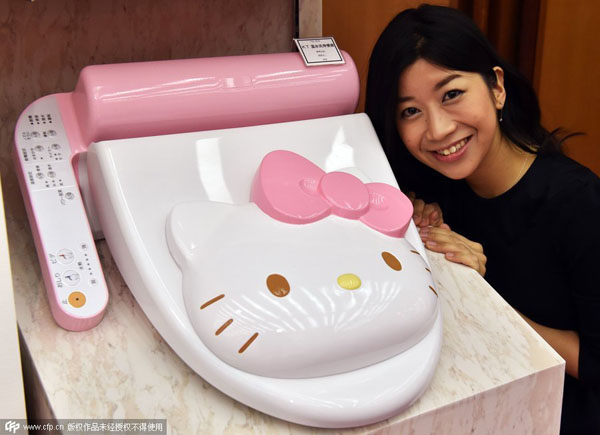
A prototype of a Hello Kitty branded toilet seat is on display at Sanrio's headquarters in Tokyo, Japan on February 2, 2015. The toilet seat, with heating and warm water shower functions, was one of the most popular items among Chinese customers in Japan during this Spring Festival holiday. [Photo/CFP] |
According to a Japanese news report, Chinese visitors spent 6 billion yuan ($959.4 million) in Japan during the holiday. Besides snapping up Japan's famous electronic products, they splashed out on domestic appliances - notably toilet seats.
This splurge on Japan's built-in bottom washers and pre-warmed luxury toilet seats has prompted many comparisons of "made in China" with "made in Japan."
Many argue that China, as the world's factory, is fully capable of producing state-of-the-art toilet seats, and they condemn those who buy Japanese goods as unpatriotic.
The depreciation of the yen has partly contributed to the Chinese spree in Japan, but Chinese consumers opt for Japanese products with good reason, despite political tensions between the two nations.
From electronic products to daily utilities, Japanese goods, such as rice cookers and toilet seats, have long been lauded for their human touch, intelligent design and sophistication. This has built their reputation not only in China, but also in the West.
In contrast, made-in-China products often make the news for their low quality and lack of sophistication, or because of a tarnished corporate image.
Food scandals like tainted milk powder and poisoned rice have angered many Chinese consumers. Food administrations in various countries have blacklisted Chinese goods in response.
Chinese shoppers are not to blame for buying a foreign product at the same or a higher price than the domestic equivalent. This just reflects their lack of confidence in Chinese goods.
As domestic consumers become more discerning, Chinese manufacturers must accept that their low-cost advantage is disappearing.
China's export-led economy has also rendered many local products as cheap copies of foreign goods.
Most Chinese, especially the better off middle class, are now free to enjoy the privilege of warming their buttocks on Japanese toilet seats.
Chinese enterprises must devote more resources and energy to product specifications and innovate technologies if they are to win back Chinese customers.
The smart phone is a case in point. Home-grown brands like Huawei and Xiaomi are selling their products globally. In 2014, Xiaomi overtook Samsung to become the best-selling smart phone brand in China, according to IHS Technology, a global information company.
Xiaomi won its consumers with a new "made in China" feature - innovation.
Chinese manufacturers must also enhance efficiency and improve quality.
The sooner they start, the better. It may take a long time yet for domestic buyers to restore their trust in "made in China".


Copyright 1995 - . All rights reserved. The content (including but not limited to text, photo, multimedia information, etc) published in this site belongs to China Daily Information Co (CDIC). Without written authorization from CDIC, such content shall not be republished or used in any form. Note: Browsers with 1024*768 or higher resolution are suggested for this site.
License for publishing multimedia online 0108263 Registration Number: 130349