|
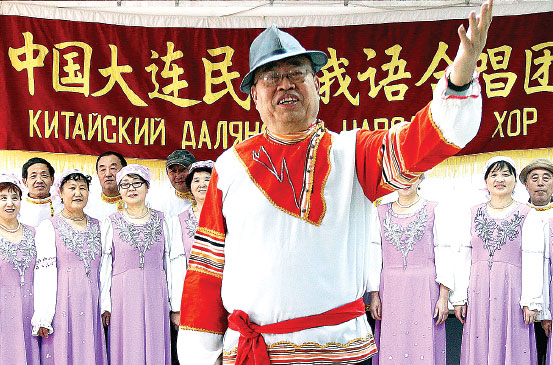
Leader Yao Guangyan and members of the 50-strong Russian Songs Choir in Dalian, Liaoning province, rehearse Night on the Outskirts of Moscow. Gao Qiang / for China Daily |
Chen Xiaoying, a 72-year-old translator, writer and expert on Russian issues, said: "The Soviet Union was one of the countries that has had the deepest influence on China, not only its military and economic structure, but also in the minds of several generations. Chinese people in their 50s, 60s and 70s have all been influenced by the Soviet Union to some degree. I'm one of them."
The relationship between the countries was always complex, ranging from closely allied in the 1950s to deeply strained from the 1960s to the late 1980s. Things only began to improve shortly before the collapse of the Soviet Union in 1991.
The change in the relationship can be seen from the various nicknames the Chinese gave to the Soviet Union, from the friendly - "Big Brother" and "Polar Bear" - to the uncomplimentary "Chauvinist" in less happy times.
The Soviet Union had its roots in the Russian Revolution of 1917, which overthrew the monarchy and initiated a centrally planned economy, a model of change and experience that was digested and adopted by a number of countries, including China.
"China set off on a national wave of learning from the Soviet Union, and considered it a 'big brother' in the 1950s. Soviet design and equipment, skilled experts and workers were sent to help China industrialize and modernize," Chen said.
During the same period, a wide range of Soviet novels, poetry, movies, songs and dances were introduced, and quickly became popular among Chinese intellectuals and the young, he added.
Chen's life has been molded by Russian and Soviet culture. "They influenced several generations of Chinese intellectuals, including me. From them, we learned about the personality of the people, especially the intellectuals' persistence in pursuing independence. They weren't afraid of the powerful, and they had the courage to sacrifice themselves. They are good examples for intellectuals across the world," he said.
According to Chen, the fact that the Soviet Union straddled Europe and Asia meant it was more amenable to Western concepts than China, and Soviet culture was the first foreign influence felt by Chinese intellectuals after the founding of the People's Republic of China in 1949.
Chen's view was echoed by Yao Guangyan, 71, leader of the 50-strong Russian Songs Choir in Dalian, Liaoning province.
Yao said he had a favorable impression of the Soviet Union when he was young, especially because of the help it offered China during the tough times in the 1950s.
He has collected more than 400 Russian songs, and the choir is regularly invited to perform in Russia. "My biggest wish is to tour and perform in 10 large cities in Russia," he said.
The choir, which has an average age of 68 and is composed of professors, engineers, translators, workers, and public servants who have been influenced by their educational or work experiences during the Soviet era.
"Only a quarter of the members of the choir can speak Russian, but they pronounce the words perfectly when they sing. I'm a little ashamed because they know more Russian songs than I do," said Alfeev Konstantin, 31, a Russian businessman in Dalian.
A fascination with history
Wu Qijian, a businessman in the United States, is a collector of Soviet memorabilia from World War II, including rifles, bullets, uniforms and helmets.
The collection has resulted in the 50-something forging friendships with others in his age group, all of whom have been influenced by growing up in the Soviet era.
"I often invite them to see my collection. We dress in military uniforms and talk like generals," he said on the phone from his home in California.
Wu says he owes his fascination to his father, who in 1951 was among the first group of Chinese to travel to the Soviet Union.
"When I was a teenager I felt that my father must have had an unusual experience in the Soviet Union because he never talked about it," he said.
He only learned of his father's experiences when he read a document written by his father during the "cultural revolution" (1966-76). "I learned the truth by reading his story. He wrote that he was placed on probation by the authorities because he had a relationship with a local girl during his time in the Soviet Union," he said.
The liaison produced a son, but at the time relationships between Soviet and Chinese citizens were not permitted, so Wu's father was repatriated and had to leave mother and child behind.
"When Sino-Soviet relations deteriorated in the 1960s, he lost all contact with the girl," Wu said.
"It wasn't until the 1990s when my father, an aircraft designer, got the chance to travel to the Soviet Union to conduct research on the Tupolev Tu-154 passenger jet. That would have given him an opportunity to try and find the woman. However, my mother was seriously ill, so he didn't go," he said.
"A friend who replaced him on the trip promised to help. He discovered that the woman had passed away many years earlier and the boy had been raised in an orphanage. He found my half-brother, but when they spoke my half-brother said he hated us and didn't want to see us," he added.
"My father never met my half-brother. That troubled him right up until his death in 2010. It was the biggest regret of his life," he said.
Zhang Xiaomin and Lu Hongyan contributed to the story.


Copyright 1995 - . All rights reserved. The content (including but not limited to text, photo, multimedia information, etc) published in this site belongs to China Daily Information Co (CDIC). Without written authorization from CDIC, such content shall not be republished or used in any form. Note: Browsers with 1024*768 or higher resolution are suggested for this site.
License for publishing multimedia online 0108263 Registration Number: 130349