Egaming is becoming big business in China and is spawning a new generation of handset heroes, as Sun Xiaochen reports.
 |
|
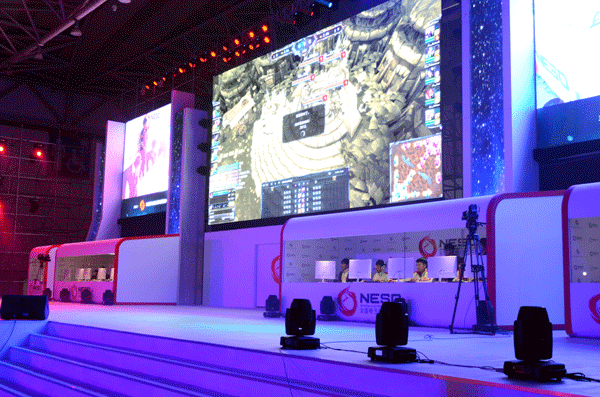
More than 70,000 fans attend the Qingdao International Convention Center to watch 15 provincial clubs compete at the National Electronic Sports Open, which concluded on Dec 7. A MU / CFP |
Dreams sometimes start in the most unlikely places - for example, a stuffy basement Internet bar in Shaoyang, a small city in Central China's Hunan province, where rebellious teenagers hang out after school.
Zhang Ning, aka xiao8, his ID in the online game community, was once one of these "hooligans" as he immersed himself in the virtual cyber-world as an escape from his parents and the challenges posed by real life.
However, Zhang didn't become a stereotypically idle Internet addict. Instead, the 24-year-old is one of China's best-known players of electronic games after winning the International Dota2 Championships with his team, Newbee, in July, and bagging a sizable share of the $5 million purse, more than double the sum earned by retired tennis ace Li Na when she won the Australian Open.
"Thanks to my involvement in competitive electronic gaming, I channeled my video game addiction into something positive, something I could work hard for as a career path," said Zhang, who recently announced a career break after getting married.
The game Dota2 is a "multiplayer online battle arena", where two teams of five players defend their "ancients", or fortresses, from their opponents. The championship, hosted by the game's developer, Valve Software in Seattle, was the highest-profile MOBA tournament in e-sports' history, and offered a record $10 million in total prize money.
Zhang's rise from a typical diaosi, an insignificant person, to accomplished gamer reflects the recent transformation of e-sports from a recreational tool with negative connotations to widespread acceptance by mainstream culture. It can also provide well-paid, if usually short-lived, careers for elite players against the backdrop of China's booming video game industry and the evolution of information technology.
At the National Electronic Sports Open, which concluded on Sunday, more than 70,000 fans crammed into the Qingdao International Convention Center to watch 15 provincial clubs compete in six individual and team events, including Dota2, League of Legends, Warcraft 3, and NBA2K Online.
Record viewing figures
The growing popularity of e-sports was clearly signposted by the huge crowd, the scenes of fans mobbing star gamers for photos and autographs, and also by record viewing figures for major online broadcasting platforms such as v.qq and pptv.
The open was the first nationwide tournament to be held since the State General Administration of Sport, e-sports' national governing body, officially recognized cybersport - defined as "intelligent competition between human players on electronic game platforms" - as the country's 99th athletic event in 2003.
"E-sports have specific rules and time limits designed specifically for person-to-person intellectual competition, whereas playing online games is just a pastime for personal recreation. There is a clear distinction between the two," said Yang Ying, deputy director of the administration's sports information center.
Recognition from the national authority, the huge fan base, and an improved public image have helped e-sports grow into a market that appeals to all types of club investors, broadcasters, and game developers and operators.
In August 2011, Wang Sicong, son of real estate tycoon Wang Jianlin, purchased Catastrophic Cruel Memory, a well-known e-sports club, for what was called a "significant sum of money", and reorganized it under a new name, iG club. He also poached players from other clubs by offering them attractive professional contracts.
"Wang's entry brought the game into a battle of capital, forcing major clubs to entice talent from each other through lavish salaries. This will reshape the e-sports landscape," said Liu Yang, a veteran e-sports observer who last year posted a 26-chapter article online detailing the development of e-sports in China from 1998 to 2009.
According to the China Gaming Industry First-Half Report for 2014, the country has more than 400 million video gamers on PC, mobile, and console platforms, and most of them are consistent e-sports fans.
The report, which is published every six months by the China Audio-Video and Digital Publishing Association and IDC Insights, said China's video game industry earned 49.6 billion yuan ($8 billion) in the first half, a 46 percent increase from the same period in 2013. Observers are now eagerly awaiting the full-year figures, which will be released at the end of December.
On Oct 19, more than 27 million fans watched South Korea's Samsung White beat China's Royal Club in the World Championships final of League of Legends, a hit title developed by Riot Games of the US. The figures are impressive, given the average 15.5-million-per-game TV audience for the NBA's 2013-14 season final series.
China's lifting of a 14-year ban on foreign video game consoles earlier this year has been seen as a further sign of the increasingly positive official attitude toward the e-games industry. That's led observers to predict further market growth, a forecast underlined by report called China's PC Online Games Market, published by Niko Partners, in which the research company estimates that over the next five years, revenue growth in the market will rise by $2 billion a year.


Copyright 1995 - . All rights reserved. The content (including but not limited to text, photo, multimedia information, etc) published in this site belongs to China Daily Information Co (CDIC). Without written authorization from CDIC, such content shall not be republished or used in any form. Note: Browsers with 1024*768 or higher resolution are suggested for this site.
License for publishing multimedia online 0108263 Registration Number: 130349