

Series of agreements aim to improve regional connectivity among nations.
 |
|
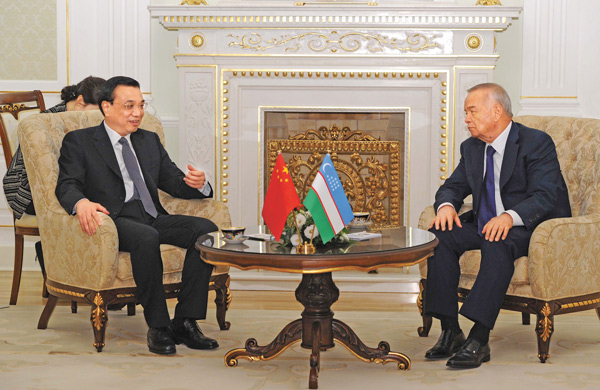
Premier Li Keqiang meets Uzbek President Islam Karimov in Tashkent on Thursday. Li will attend a meeting of the prime ministers of the Shanghai Cooperation Organization member states on Friday.[Rao aimin / xinhua] |
The signings are slated to take place during a meeting of the prime ministers of the SCO members.
A groundbreaking agreement on road construction between Asia and Europe is likely to be included. Such an agreement would create conditions for a Eurasian transport corridor between Lianyungang, Jiangsu province, and St. Petersburg, Russia, they said.
Such moves would help tap the huge cooperation potential between China and other SCO members, as well as help maintain the stability of the region, which faces terrorist threats and uncertainties after the planned withdrawal of US troops from Afghanistan in 2014, they added.
Premier Li Keqiang will make his debut with the SCO at the meeting in Tashkent, Uzbekistan's capital. His counterparts from Russia and the Central Asian countries of Kazakhstan, Kyrgyzstan, Tajikistan and Uzbekistan will also participate.
The premier is slated to hold talks about the expansion of the organization. They will also discuss the establishment of a development bank for the bloc. He is also expected to agree on a number of economic and trade deals with Uzbek Prime Minister Shavkat Mirziyoyev.
Li flew to Uzbekistan after concluding a visit to Romania, where he met with government leaders from Central and Eastern Europe.
Gao Yusheng, former Chinese ambassador to Uzbekistan, said the meeting aims to implement a consensus reached by the six countries' top leaders in Bishkek, Kyrgyzstan, in September by raising specific projects. Interconnectivity cooperation, infrastructure construction and investment facilitation will be the top priorities.
The total economic output of SCO members reached more than $10 trillion in 2012, while foreign trade stood near $5 trillion, statistics show. China is now the top trading partner of Russia and Kazakhstan, and the second-largest of Uzbekistan and Kyrgyzstan.
But current economic relations between China and the other five members still fall short of many insiders' expectations. Huge potential is believed to exist as the six cover a total area of 30.2 million square km with a combined population of 1.53 billion.
China has been long calling for closer coordination among SCO members regarding customs, e-commerce and investment to boost trade, as the "inconvenience costs" of trade are three to four times higher than the cost of tariffs for international trade.
Gao said better transportation connectivity, especially the possible Asia-Europe transportation corridor, will deepen and expand cooperation among the SCO members in various fields besides trade.
Sun Zhuangzhi, a Central Asian studies expert at the Chinese Academy of Social Sciences, agreed with Gao, adding this meeting's participants are also likely to propose detailed measures to strengthen people-to-people exchanges.
During his first visit to Central Asia in September after taking office in March, President Xi Jinping announced that China will provide 30,000 government scholarships over the next decade to students from SCO members. He also invited 10,000 teachers and students from Confucius Institutes to research or study in China during the period.
However, experts highlighted looming security concerns that may cast a shadow over SCO cooperation. Those concerns include an influx of the "three evil forces" — terrorism, separatism and extremism — in the region, and the planned withdrawal of US troops from Afghanistan in 2014 followed by a presidential election there in the same year.
Less than a week before the meeting, a group calling itself the Turkestan Islamic Party claimed responsibility for last month's attack in Tian'anmen Square in Beijing, which left two tourists dead and another 40 injured.
Beijing responded that the group is the same terrorist organization as the East Turkestan Islamic Movement, a separatist group listed as a terrorist organization by the United States, the United Nations and China.
"The SCO members need to further shore up both bilateral and multilateral cooperation in fighting against terrorists," said Zhang Zhiming, former Chinese ambassador to Uzbekistan and Kyrgyzstan.
Zhang cited the cooperation between China and Uzbekistan, both of which border Afghanistan, as a successful example, calling for more effective information sharing and criminal deportation.
The SCO is in a critical stage as the 12-year-old group begins its second decade, said Chen Yurong, a senior researcher at the China Institute of International Studies.
The first decade was a kind of startup period when the organization focused on setting up working mechanisms and anti-terror legal system, while the second decade is going to witness more practical cooperation and concrete achievements in various sectors, Chen said.
Contact the writer at zhaoshengnan@chinadaily.com.cn
|
|
|
|
|
|
|
|

Copyright 1995 - . All rights reserved. The content (including but not limited to text, photo, multimedia information, etc) published in this site belongs to China Daily Information Co (CDIC). Without written authorization from CDIC, such content shall not be republished or used in any form. Note: Browsers with 1024*768 or higher resolution are suggested for this site.
License for publishing multimedia online 0108263 Registration Number: 20100000002731 













 Op Rana
 Berlin Fang
 Zhu Yuan
 Huang Xiangyang
 Chen Weihua
 Liu Shinan