Comments
  Print
Print  Mail
Mail  Large Medium Small
|
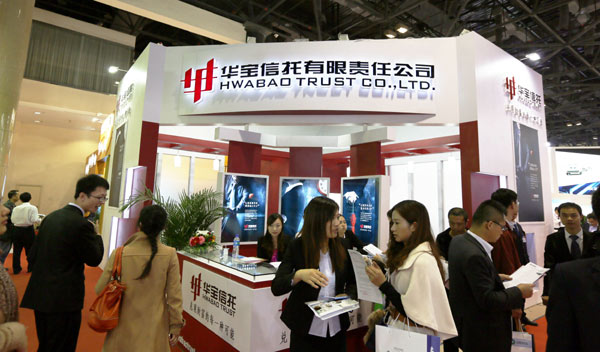 Hwabao Trust Co Ltd promotes its services at the recently held Beijing International Financial Expo. Assets under management of China's trust industry grew by seven times from 2007 to 2012, exceeding 10 trillion yuan ($1.64 trillion) as of the end of the third quarter of 2013. [Photo / Provided to China Daily]
|
Consultancy warns that nation's reform could undermine sector
The revenues of China's 10 trillion yuan ($1.64 trillion) trust industry are at risk as the government deepens financial reforms, research from Ping An Trust Co Ltd and McKinsey & Co showed on Thursday.
About 88 percent of industry revenues are at risk in the long run, and 39 percent of earnings are expected to disappear completely within five years, according to the research.
Assets under management of China's trust industry grew by seven times from 2007 to 2012, exceeding 10 trillion yuan as of the end of the third quarter of 2013. That figure made the trust industry the second-biggest financial sector in China, after banks.
But the trust sector now earns most of its income from financing riskier borrowers and helping banks and other institutions buy assets that they cannot invest in due to regulatory restrictions.
"This part of the business, which we term 'conduit business', is likely to vanish completely as China continues its relaxation of the usage of the trust structure" by other types of companies," said Xu Jun, a partner at McKinsey.
Investment trusts have exploded on the back of a class of borrowers who can't get credit from banks due to regulations or their risk profiles. Trusts have stepped in to fill the void by linking borrowers to investors and savers seeking higher returns.
About 49 percent of the industry's revenue comes from the private placement investment banking business. But as Chinese banks extend more loans to small and medium-sized enterprises and other relatively high-risk borrowers, and capital markets develop, "how big a role will be left for trust companies and at what margins is unclear."
If they're to survive, China's trust companies need to develop two potential sources of revenue that offer great potential: alternative asset management and private wealth management, according to the report.
These revenue sources are also forecast to be among the fastest-growing financial activities over the next decade.
By 2015, the nation will have more than 1.9 million high net worth individuals, with total investable assets hitting about 58 trillion yuan and offering "huge potential" for the private wealth management business, according to McKinsey.
Ping An Trust, for instance, moved into private wealth management in 2008. It developed China's first family trust this year.
"We will further promote the family trust, eyeing customers with investable assets exceeding 50 million yuan," said Han Xiao, assistant general manager of Ping An Trust.
 Honda models at 2013 Guangzhou auto show
 Honda Jade at the 2013 Guangzhou auto show
 Toyota's new Reiz debuts at 2013 Auto Guangzhou
 Jimmy Lin Zhiying, models at Toyota pavilion
 Volvo all-new S60L world premiere at Guangzhou auto show
 2013 Guangzhou auto show carmakers' eventers
 Models at Volvo pavilion at 2013 Guangzhou auto show
 Lexus new hybrid hatch CT200h world premiere in Guangzhou
Copyright 1995 - . All rights reserved. The content (including but not limited to text, photo, multimedia information, etc) published in this site belongs to China Daily Information Co (CDIC). Without written authorization from CDIC, such content shall not be republished or used in any form. Note: Browsers with 1024*768 or higher resolution are suggested for this site.
License for publishing multimedia online 0108263 Registration Number: 20100000002731