 |
|
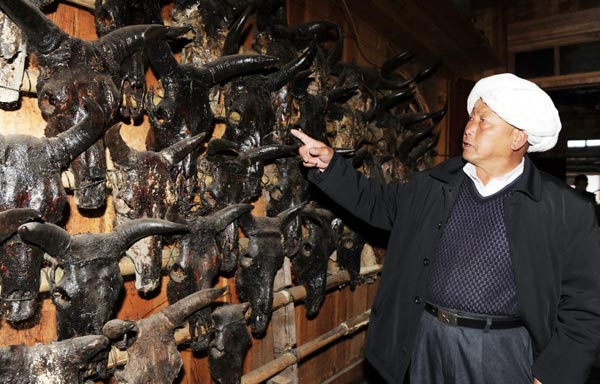
Alusung, 70, a former tribal chief of a Deng village in Zayu county in Tibet, shows off his collection of ox skulls hanging on the wall of his house.[Photo/ Xinhua] |
It was not long ago the Deng people in Tibet's Zayu county led primitive lives, dictated by ancient rituals and beliefs. Liu Xiangrui and Da Qiong discover that while the modern world has reached this remote community, traditional ways still thrive.
|
|
|
|
In the 1950s, Alusung inherited his father's position, becoming a teenage tribal chief. The 70-year-old is now the village head in Shaqiong village of the Tibet autonomous region's Zayu county.
Well-known for his colorful anecdotes, Alusung has long been the public face of the Deng people, the nation's smallest ethnic tribe. Deng people, also called Dengba, are not among the 56 officially recognized ethnic groups in China.
"The column for ethnicity on our identity cards reads 'others'," Alusung says.
Deng people live mainly in the mountainous regions at an average altitude of 1,000 meters east to the Himalayas and west to the Hengduan Mountains.
From the 1940s, some members of the tribe have been migrating to the valley in lower Zayu. The Deng population in Zayu has grown from about 200 people, to more than 1,800.
According to Alusung, Deng people used to lead a primitive life on the mountains. They grew simple crops such as corn. When food was short, they would go hunting or dig for wild vegetables.
Since the 1950s, most Deng people have moved from the mountains to open ground. Over the years, they have connected with the rest of the world.
With 55 households, Shaqiong village is the largest Deng habitat in Zayu.
Today, the village enjoys many of the amenities of modern life. Most houses are well built and equipped with tap water, solar heaters, and TV sets. There is even a village library. With improvements in traffic and living environment, the village has become a tourist destination. Alusung is the richest man in the village. The 50-some ox skulls hanging on his wall are a sign of his wealth.
According to villagers, ox skulls are a traditional symbol of wealth. They can only be kept when the owner kills the bulls to share the meat with other villagers. Alusung often kills bulls and shares the meat with the poor in the village.
Alusung is very proud of being the only person permitted to bring a knife into the Great Hall of the People in Beijing as a member of the National Committee of the Chinese People's Political Consultative Conference in the 1980s.
It's a Deng tradition for men to carry a knife. The elder villagers still carry them today. Like other Deng males, Alusung was given a hunting knife when he was a child and has carried it on his hip ever since.
|
|
|
|
|
|
|
|


Copyright 1995 - . All rights reserved. The content (including but not limited to text, photo, multimedia information, etc) published in this site belongs to China Daily Information Co (CDIC). Without written authorization from CDIC, such content shall not be republished or used in any form. Note: Browsers with 1024*768 or higher resolution are suggested for this site.
License for publishing multimedia online 0108263 Registration Number: 20100000002731 


















 Raymond Zhou:
 Pauline D Loh:
 China Dream
 China Face
 Ye Jun:
 Pauline D Loh: My Chinese Kitchen