Comments
  Print
Print  Mail
Mail  Large Medium Small
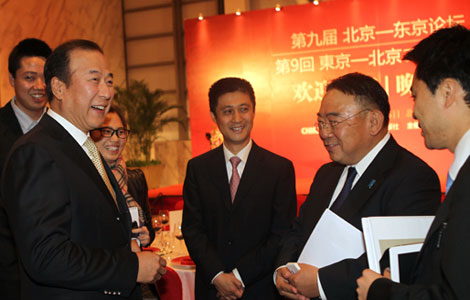
When Toshihiro Soejima, the director of The Genron NPO, began his annual fundraising efforts for the Beijing-Tokyo forum this year, he was worried "we won't be supported by companies”.

He had reason for his pessimism about the forum, which is co-sponsored by the nonprofit Genron NPO and China Daily newspaper in China every year.
Relations between Asia's two giant neighbors have been hit hard by their territorial dispute since September 2012, with polls indicating mutual goodwill has dropped to a record low for the past decade.
But the result was the opposite of what Soejima expected.
"Actually many companies, about 50, supported us to attend the forum, even one to two more than last year,” Soejima told China Daily on Saturday on the sidelines of the forum, which ended on Sunday in Beijing.
"It means that although companies in Japan are worried about the current political difficulties between China and Japan, they believe a good relationship between the two countries is very important,” he said. "Many companies, many people, strongly hope that the relationship will be improved.”
As with the Japanese firms, the eagerness to improve the deteriorating bilateral ties through personal efforts could be sensed through almost every detail of the forum.
Yasushi Akashi, former UN under-secretary-general, and now chairman of the board of the nonprofit, nonpolitical organization International House of Japan, said a typhoon in Tokyo did not prevent participants from boarding an aircraft to China.
Li Wei, a senior Japanese studies expert and a frequent participant in the forum, began her talk on Friday with strong congratulations to Japan on successfully bidding for the 2020 Olympic Games.
Everyone attending the forum knew the difficulty of holding the forum after it was initially delayed, and all showed their appreciation by extending additional hospitality to the other side.
But in every discussion, the participants on each side engaged in heated debates on politically sensitive topics, such as the Diaoyu Islands issue and historical disputes.
The crossing of swords could be heard and felt frequently in the discussions.
In a simple case, a college student in the audience asked a question about the Japanese media's distorted coverage of China, and a senior participant from the Japanese side immediately hit back by saying unfair coverage of Japan has been staged by the Chinese media.
China has been trying hard to remove the key obstacles in bilateral ties and the territorial and historical issues by offering proof and recalling the past friendship. But Japan has mostly kept silent on those sensitive issues and wanted to move ahead by putting aside those topics.
Compared with the unity of the Chinese side, the Japanese group seemed to be more divided in their opinions about China, showcasing the different thoughts toward China within Japan.
Even those Japanese participants who are old China hands contradicted their previously expressed opinions on sensitive bilateral issues, seemingly in fear they ran counter to the Japanese government stance.
The feeling was intense, with anxiety and expectations filling the air.
But whenever the discussions were over, old friends from both sides came together to take pictures, shake hands and laugh together.
Many of them think that the countries' relationship is at its worst point in the past 40 years, but most said they are optimistic about future improvement. However, none could voice a solid reason for their confidence.
All the signals seemed contradictory.
For some of those politicians who have devoted decades of their life to nurturing the bilateral ties, the reason for their perseverance might be simple.
"Japan and China should not, cannot and will not be against each other. So you have to improve relations”, Koichi Kato, president of the Japan-China Friendship Association, said.
The senior Japanese politician rushed about in support of bilateral ties in recent months despite his physical frailty.
Zhao Qizheng, a former minister of China's State Council Information Office, said Kato even had his ancestral house burned down by right-wingers in Japan years ago because of his objections concerning the Yasukuni Shrine, which honors Class-A World War II war criminals and is seen as a symbol of Japan's militarism.
Kato said, "Our two countries should never wage a war. Therefore, the only path ahead of us is to improve the relationship.”

 Inside PLA Navy's 1t nuclear-powered sub force
 Guangzhou airport postpones flights due to fire
 Visitors pack Fragrant Hills Park in Beijing
 Where art thou, my love?
 2013 China Intl Travel Mart kicks off in SW China
 Welcome reception of Beijing-Tokyo Forum held in Beijing
 Chinese riot police team arrives at Liberia
 After smog, a sunny day in NE China city

Copyright 1995 - . All rights reserved. The content (including but not limited to text, photo, multimedia information, etc) published in this site belongs to China Daily Information Co (CDIC). Without written authorization from CDIC, such content shall not be republished or used in any form. Note: Browsers with 1024*768 or higher resolution are suggested for this site.
License for publishing multimedia online 0108263 Registration Number: 20100000002731