Comments
  Print
Print  Mail
Mail  Large Medium Small
 |
|
China Daily Publisher and Editor-in-Chief Zhu Ling (left), former UN under-secretary-general Yasushi Akashi (center) and Kudo Yasushi, representative of the Japanese nonprofit think tank The Genron NPO, pose after the conclusion of the Ninth Beijing-Tokyo Forum in Beijing on Sunday. Zou Hong / China Daily |
Experts fear Tokyo's proposal is an attempt to gain offensive capability
Veteran Chinese experts and military officers challenged the "active pacifism" recently pushed by Japanese Prime Minister Shinzo Abe, saying Beijing welcomes true pacifism, but in this case it appears there may be other intentions.
"The idea of active pacifism is a major change in Japan's defense visions. It will also highly likely be realized by revising the law, a situation that has never happened in Japan since the war," Li Wei, director of the Institute of Japanese Studies at Chinese Academy of Social Sciences, said at the Beijing-Tokyo Forum over the weekend.
Abe has been pushing hard the concept of "active pacifism" — increasing Japan's engagement in safeguarding the world's peace and stability — since September. He frequently talked about the idea during his trip to New York for the United Nations General Assembly meeting that month.
Li said she is concerned that Japan is making big moves in realizing the idea. Although it is unclear whether Japan will amend its Constitution, the Japanese government is to revise explanations of Article 9 of the Constitution, she said.
In a speech in New York, Abe said revising the Constitution is necessary so Japan can regain the right of collective self-defense to contribute to world peace.
Article 9, seen as the core of the postwar "Peace Constitution", outlaws war as a means to settle international disputes involving Japan. It also stipulates that, to accomplish the aim, armed forces with war potential will not be maintained in Japan.
"Where will Japan's security policies go ahead and how will they realize it? We'll follow closely," Li said.
She asked Japan to provide a detailed explanation in that regard to East Asian countries, especially China, to avoid misunderstandings from all sides.
Major General Yang Yi from the University of National Defense said in his eyes, the idea is a strategy of "borrowing a boat to sail".
"It is trying to gradually break the policy of purely defensive defense under the name of strengthening the Japan-US security alliance.
"We support real pacifism, but not such a one that excludes others," Yang said.
Wu Huaizhong, director of the department of Japanese politics of the Institute of Japanese Studies at the Chinese Academy of Social Sciences, said Japan's plan of active pacifism is not confined to making contributions to the world but extends to a much wider area, which even includes Japan's security in the ocean and airspace.
"Besides, Abe said he referred to international affairs when talking about active pacifism. But a lot of content (in the proposal) is targeted at the region and China."
Chen Jian, former under-secretary-general of the United Nations and former Chinese ambassador to Japan, said he is "worried about the active pacifism as it happened at the same time" the Liberal Democratic Party of Japan stepped back on the history issue and increased its hostility against China.
Former UN under-secretary-general Yasushi Akashi said there are also various views in Japan on revising the Constitution.
For instance, "there is a strong voice that although the Constitution has some defects, we should still keep it. I think more than half of the Japanese hold the idea".
"It is difficult to put down all the opinions to one."
Noboru Yamaguchi, professor of the National Defense Academy of Japan, said Japan is also concerned about China's military moves, such as the Chinese navy's frequent passing through international waterways just beside Japan's territorial waters to enter the Pacific.
"It is justified, but there were no such things five years ago. So it is reasonable for us to worry."
Osamu Onoda, a retired officer of the Japanese Air Self-Defense Force's Air Training Command, said he is impressed by the ongoing active military communication between Washington and Beijing.
In contrast, security communication between Japan and China lags far behind, he said.
Former Japanese Ambassador to China Yuji Miyamoto said East Asia has entered such an era that "we have to have a large platform for dialogue, a security mechanism that makes everyone assured".
lixiaokun@chinadaily.com.cn
 Inside PLA Navy's 1t nuclear-powered sub force
 Guangzhou airport postpones flights due to fire
 Visitors pack Fragrant Hills Park in Beijing
 Where art thou, my love?
 2013 China Intl Travel Mart kicks off in SW China
 Welcome reception of Beijing-Tokyo Forum held in Beijing
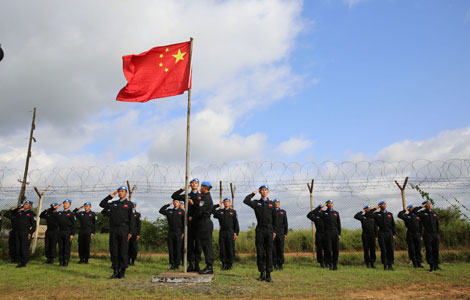 Chinese riot police team arrives at Liberia
 After smog, a sunny day in NE China city
Copyright 1995 - . All rights reserved. The content (including but not limited to text, photo, multimedia information, etc) published in this site belongs to China Daily Information Co (CDIC). Without written authorization from CDIC, such content shall not be republished or used in any form. Note: Browsers with 1024*768 or higher resolution are suggested for this site.
License for publishing multimedia online 0108263 Registration Number: 20100000002731