Gender income gap continues to widen
Although China has made remarkable progress in narrowing gender inequality, challenges including the income gap between men and women remain, said top officials from the country's largest women's organization on Wednesday.
Shen Yueyue, the newly-elected president of the All China Women's Federation, said China, which is home to one-fifth of the world's female population, shoulders a big task in promoting gender equality.
 |
|
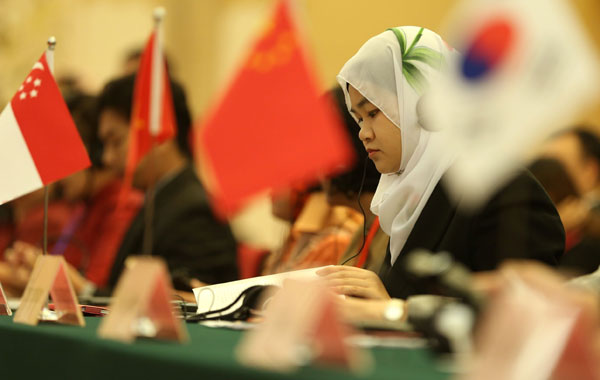
Delegates take part in the Fifth East Asia Gender Equality Ministerial Meeting in Beijing on Wednesday. Some 120 delegates from 13 countries in East Asia attended. JIN LIWANG / XINHUA |
"China, as a major developing country, faces numerous challenges and difficulties whether in economic and social development or in the process of gender equality," she said.
Shen made the remarks at the opening ceremony at the Fifth East Asia Gender Equality Ministerial Meeting held in Beijing.
More than 100 officials from 13 countries including China, the Republic of Korea and Thailand will discuss gender equality in government policies, eradication of violence against women and eliminating gender discrimination in employment during the two-day meeting.
"There are gaps between women and men in terms of employment, resources and income," said Song Xiuyan, vice-president of ACWF, who delivered the keynote speech at the opening ceremony.
From 1990 to 2010 the income gap between men and women widened, according to three national surveys.
The annual income of female urbanites was about 78 percent of that of their male counterparts in 1990. The ratio dropped to 70 percent in 1999 and 67 percent in 2010.
In rural areas, the ratio was about 79 percent in 1990 but declined to 56 percent in 2010.
Wang Xiaolin, director of the research division of the International Poverty Reduction Center in China, believe women and men concentrating on different industries has partly lead to the widening income gap.
"Many female migrant workers stay at the low end of the service sector, such as working as waitresses in restaurants, while men take more positions in the manufacturing industry.
"China's manufacturing industry has undergone rapid upgrading, and pay in this sector has increased much faster than the traditional service sector, which means men's incomes are increasing quicker than women's," he said.
Chinese women's influence in the household and on the well-being of children has increased significantly but their influence in the workplace and in politics has hardly increased, according to a report called "Inequality in China: A Case Study" released by Save the Children, an international NGO dedicated to promoting children's rights and welfare, on Monday.
Statistics from the All China Federation of Trade Unions also showed women's declining representation in enterprises' governing bodies.
Women made up about 32 percent of companies' board of directors in 2011, a decline of 11 percentage points compared with 2005.
Gender inequality is also a pressing issue in many other countries.
Cho Yoonsun, minister of Gender Equality and Family from the Republic of Korea, said although many countries have improved the status of women in the past two decades, none can claim to have achieved full gender equality.
She said about 63 percent of women in their 20s participate in the labor market in her country, nearly identical with their male peers. Yet this trend reverses as they enter their 30s, with 56 percent of women and 93 percent of men working, and the gender gap in the labor market widens into their 40s and afterward, she said.
"A major reason for this phenomenon is that no mother is free from childcare duties and chores, while fathers remain unconstrained by domestic responsibilities."
Song, from ACWF, urged countries from East Asia to share their experiences in promoting gender equality, stressing that China is committed to perfecting the legal system and implementing national policies to ensure gender-equality.