Micro blogs make graft fight hot news
 |
|
Luo Changping used his Weibo to accuse Liu Tienan of abuse of power. Provided to China Daily |
Sina Weibo now has more than 368 million users, a huge jump from the 50 million registered users it had roughly three years ago. Although an increasing number of people regard social media, especially micro blogs, as an effective means of tackling corrupt officials, the official attitude to it is conservative and cautious.
"Exposing officials online is not an official way of reporting corruption," said Zhang Shaolong, an inspector from the petition office of the Commission for Discipline Inspection of the Central Committee of the CPC, during an online interview in May.
"The authorities investigated a number of officials after leads were provided on the Internet, but we have to admit that there are concerns about online tip-offs. Some of the information posted was false and some posts were simply a means of letting off steam and were very difficult to verify," he said. He urged people to report corrupt officials through the confidential, official channels, because he feared whistleblowers may be putting their lives at risk by making accusations on a public forum.
In April, a number of popular Chinese websites provided links to government departments' official anti-corruption websites, but experts said most people still prefer to use the unofficial channels because of the huge amount of public attention they receive.
Attracting attention
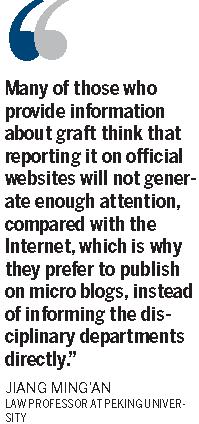
"Many of those who provide information about graft think that reporting it on official websites will not generate enough attention, compared with the Internet, which is why they prefer to publish on micro blogs, instead of informing the disciplinary departments directly," said Jiang Ming'an, a law professor at Peking University.
"It also highlights the negligent way in which the authorities sometimes deal with reports from the public," said Jiang, who has been invited to participate in a central government conference on anti-corruption work. He added that officials should be prepared to defend themselves if members of the public cast doubt on their probity.
Meanwhile, the disciplinary authorities must investigate information posted on social networking platforms and provide public feedback, he said. "If the information provided is false, the authorities must quickly make that clear. Not all online reports are 100-percent accurate and we need to protect innocent officials."
If there are no rules covering online allegations of corruption, especially on some micro-blogging platforms, the potential exists to damage the reputations of officials, infringe their privacy or even libel them, he said.
To avoid these problems, the government should formulate laws to regulate online allegations of corruption. The best way of doing that would be to write them into an anti-corruption law that many experts have been calling for over a long period. In addition, those who attack officials for reasons of personal malice will be forced to justify the false allegations if the case becomes the subject of an official investigation.
Luo Changping said the success of his complaint against Liu was an isolated event and doesn't mean that the system has improved.
Ren Jianming, director of the clean governance research and education center at Beihang University in Beijing, said social media is just one way of cracking down on graft and will not tackle the root cause of the problem.
"Online anti-corruption efforts will encourage more people to provide information, give their opinions and participate in supervision, but it's not a practical way of solving the problems caused by graft," he explained.






- CPC elects more grassroots delegates to upcoming national congress
- Jinan city reported to have fastest bike-sharing riders
- Shanghai lacking in environmental protection, inspectors find
- Foreign professor from Wenzhou-Kean University helps tackle water issues
- Baidu uses AI technology to help abducted child find family