'Spring' in the air for NGOs?
Reform of the rules on social organizations will expand their role in Chinese society, report Tang Yue and He Dan in Beijing.
In some ways, Zheng Xiaojie is the best storyteller in China. During the past decade, her narration and descriptions of on-screen events have helped thousands of blind and visually impaired people gain a better real time appreciation of movies.
However, this talkative woman always has a hard time explaining the organization she runs - Beijing Hongdandan Educational and Cultural Exchange Center. Established in 2003 by Zheng and her husband, Wang Weili, the organization is an NGO in all but name. It aims to improve the quality of life for the visually impaired and receives most of its funding through foundations and private donations.
But, despite being a nonprofit organization, Beijing Hongdandan is not an NGO; instead, it's registered as a business.
 |
|
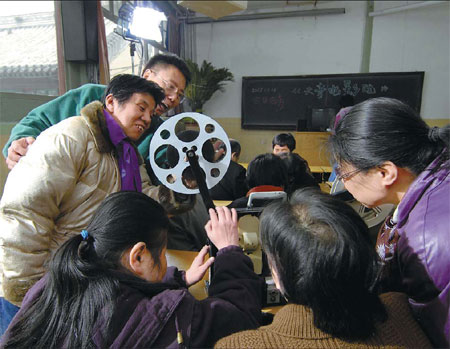
Visually impaired people learning about film projectors at the Beijing Hongdandan Educational and Cultural Exchange Center in 2007. Provided to China Daily |
"I've lost count of the number of times we tried to register as an NGO, but it is extremely difficult under the current system," said Zheng.
Her dilemma is far from unique. According to existing laws, an organization needs to find an official government body to supervise its affairs before it's allowed to register with the civil affairs office as an NGO.
That, however, is almost mission impossible, especially for grassroots outfits. It is not the duty of government agencies to take charge of NGOs, and many are reluctant to do so because responsibility for any misconduct by the NGOs will be laid at their doors.
China has about 470,000 registered civil society organizations - associations of nongovernmental groups that provide services to the public - but the NGO research institute at Tsinghua University estimates that a further 3 million remain unregistered.
Welcome news
Last month's National People's Congress, the most important annual event in the country's political calendar, brought some welcome news. Four types of NGO - industrial associations, charities, community services and organizations dedicated to the promotion of technology - will soon be allowed to register directly and without the need to find a government backer. It's expected that details of the new registration policy will be unveiled by the end of the year.
NGOs have greeted the news with cautious optimism, but they admit to concerns about the implementation of the new policy and the limited scope of direct registration.
Meanwhile, academics regard the new rules as an indication of the new leadership's vision of the State's relationship with society, and of its intention to extend the roles played by NGOs and individuals in the world's second-largest economy.
"We have repeatedly heard 'spring is coming for NGOs' for many years but have always felt let down. But, this time, I think it really is coming," said Deng Guosheng, a professor who specializes in NGO studies at Tsinghua University. "Before, we had hints from the Ministry of Civil Affairs, but this time round it's a NPC decision, one with legal backup."
Wang Ming, Deng's fellow researcher at Tsinghua, said the reform of the registration system reflects a fundamental shift in official attitudes toward civil societies and marks the starting point in another round of social reform, following the market-oriented reforms that began in 1978.
"The government has long operated from the perspective of a total State, overseeing everything that happens in the country and regarding NGOs as a challenge to its authority," said Wang. "Now, it increasingly sees NGOs as a cooperative 'third sector', in addition to the roles played by the government and business.
For Wang, the realization of "small government, great society" is a three-step process. The reform of the registration system is the first step, one that ensures the right to free association.
The second step will involve allowing NGOs and businesses to become the main suppliers of social services. The final move will be to encourage public self-governance.
"The current system politicizes some issues that could be resolved through low-level negotiation and community action. Problems shouldn't be a cause of disharmony between the people and the government," Wang said.