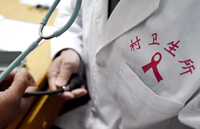
Medics and health officials have called for more measures to better protect hospital workers exposed to HIV/AIDS, as well as to deal with the fallout of any resulting infection.
The National Center for the Control and Prevention of AIDS and Sexually Transmitted Diseases issued guidance on exposure some years ago, including precautions.
 |
|
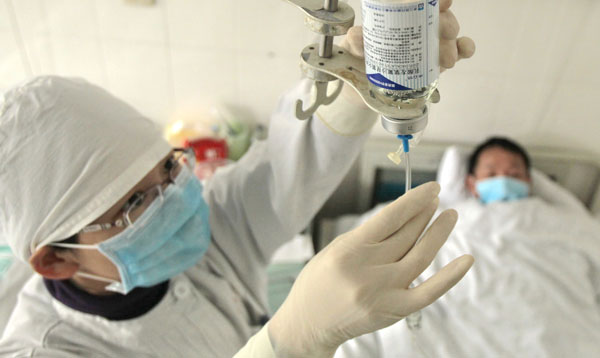
A nurse adjusts the medication of an AIDS patient at a hospital in Nantong, Jiangsu province, on Thursday. [Xu Congjun / For China Daily] |
What the country lacks is follow-up procedures, experts said.
“We already have a sound urgent-response system to occupational exposure,” said Sun Xinhua, deputy inspector for the Ministry of Health’s disease prevention and control bureau, at a news conference on Wednesday.
“However, we need to improve the management that comes after emergency treatment, such as how to assess the harm of the exposure and how to compensate for that, in order to give medical workers more security.”
The compensation policy would also need to cover the side effects of the preventive medicines people who are exposed to HIV at work must take.
“Symptoms can include headaches, fevers, nausea and discomfort of the alimentary canal,” explained Zhao Yan, deputy director of the national center’s office of treatment and care. “They fade when someone stops taking the medication, but it’s possible individuals can suffer impairment to organ functions.”
She said the center has been working on a plan on how to assess and compensate for occupational exposure to HIV, ever since Premier Wen Jiabao suggested the country should add exposure to blood-borne viruses to the list of occupational diseases as soon as possible.
China had 1,043 cases of occupational exposure to HIV last year, although none resulted in an infection, according to the center.
“We haven’t found any infections through occupational exposure in the past few years,” said Wu Zunyou, director of the center. “Of course, the exposure does put huge mental pressure on medical workers, while the preventive medicines can make them feel very uncomfortable.”
A surgeon in Beijing, who did not want to be identified, said he would prefer that guidance on post-exposure response was posted in operating rooms for every surgeon to see, as well as specific standards for when preventive medicines cause serious side effects or fail to work.
“Different surgeries need different plans to lower the risk of exposure,” he said. “For example, HIV is rarely transmitted through tears, and there is little bloodshed in eye surgery. However, in brain surgery, where we need to drill through a patient’s skull, bone and blood will fly into the air. If a patient has a high viral load, it’s easier for surgeons to get infected.”
He emphasized that such standards are not just for dealing with operations on HIV carriers. But people with other conditions, such as SARS, hepatitis and tuberculosis.
However, regardless of the type of virus, Fu Yan, a head nurse at Beijing You’an Hospital, which provides anti-viral treatment for HIV, insisted that universal precautions are needed to prevent medics from being exposed to patients’ blood and other bodily fluids.
“The emergency response and compensation guidance show that government cares,” she said, “but taking precautions is the most important thing.
“I don’t want any of us to have the chance to ‘enjoy’ such policies.”



Copyright 1995 - . All rights reserved. The content (including but not limited to text, photo, multimedia information, etc) published in this site belongs to China Daily Information Co (CDIC). Without written authorization from CDIC, such content shall not be republished or used in any form. Note: Browsers with 1024*768 or higher resolution are suggested for this site.
License for publishing multimedia online 0108263 Registration Number: 130349