|
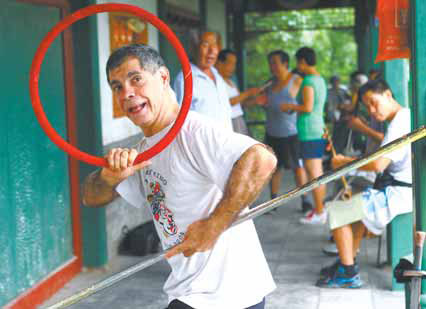
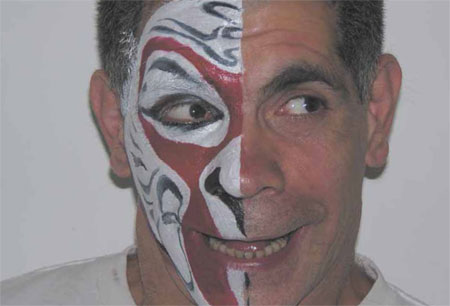
Ghaffar Pourazar practices Peking Opera at Taoranting Park in Beijing. Zou Hong / China Daily |
The colorful makeup of Peking Opera masks Ghaffar Pourazar's nationality, and at the same time reveals the lifelong dedication of a true lover of the art, Raymond Zhou discovers in Beijing.
The guard at the entrance took one look at Ghaffar Pourazar and waved him through. He did not have to pay the 2 yuan (32 cents) entrance to Taoranting Park in southern Beijing as we took a weekday stroll through it recently.
Pourazar, or Gefa in Chinese, is one of the multitude of Peking Opera practitioners who vocalize or play the fiddle, using the park as their main rehearsal venue. These are mostly amateurs with a passion for the traditional art, and also a few retired professionals who relive their glory days by reprising the roles they used to sing.
But Gefa is in a league of his own. The Englishman of Iranian descent is not just a fan of Peking Opera, but also a practicing actor of the Chinese art. And more than his Chinese peers, he takes it around the world - teaching, demonstrating and performing.
Like the Chinese connoisseurs, Gefa cannot help lamenting the three-decade decline of the genre.
"People get concerned when they lose something valuable," he says. "And Peking Opera has reached that stage, or even beyond that." One sign, according to Gefa, is the unwillingness of professionals to have their children carry on the baton. It is hard to make a living as a Peking Opera performer.
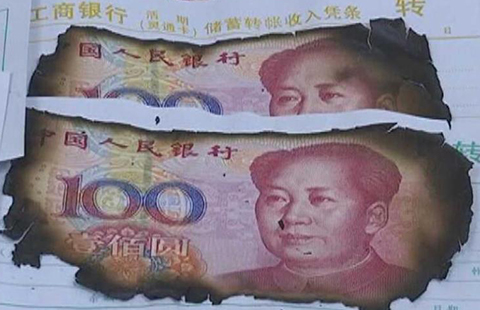
Gefa recounts an incident in the early 1990s. Guan Sushuang, a prominent Peking Opera performer known for her warrior roles, was once invited to appear in a television variety show. She was paid 100 yuan for it. But the young pop singer who appeared alongside her was given several hundred times that amount.
"With the 100 yuan, Guan bought a few bottles of liquor, and the next day they found her dead next to the empty bottles," Gefa says.
Gefa knows firsthand how much training a great master like Guan must have invested before she could attain her level of artistic height. He was 32 when, in 1993, he caught a Peking Opera performance on tour in London. He was so awestruck that he gave up his job as a computer animator and packed up and left for Beijing to study with that same opera company.
Life in Beijing was hard then, and training was even harder. Most of his classmates were half or even a third his age.
Gefa specializes in the warrior category, and his signature role is the Monkey King. Whenever he has an international audience, he will sprinkle his dialogue with English narration. Although the projection of subtitles is popular in China, and even Chinese lyrics are displayed, Gefa is not crazy about this.
He thinks the subtitles distract the audience and the English subtitles cannot convey the nuances of the language.
Having studied theater arts in the United Kingdom, Gefa is familiar with the stylized delivery of lines in traditional plays such as Shakespeare. He has used the similarity between the two art forms and come up with his own way of line reading.
It sounds like Peking Opera when you first hear it, but listen harder and it is English - somewhat like the recitative lyrics of Italian opera, with a vague melodic line beneath highly enhanced words.
The Peking Opera Demystified show, which Gefa created and which uses this approach, has become a hit. He has been taking it to universities and international festivals, including the upcoming International Design Festival at Beijing's 798 Art Zone at the end of September. In the show Gefa describes Peking Opera history, techniques and characters through many different characters he performs.
As Gefa recalls, there were a few foreigners who studied Peking Opera seriously in Beijing in the early 1990s. Then they dropped out one by one. However, Chinese television stations love to paint up foreign faces and push them onto the stage after some cursory training.
"And Chinese audiences applaud loudly no matter what the standards," Gefa complains.
On top of that, he is not happy that pop culture in China has bred a coterie of foreigners who thrive on a few gimmicks such as telling Chinese jokes, performing cross-talk or singing Chinese pop tunes.
Gefa first appeared on the star-making New Year's Eve gala in 1996, but as a serious Peking Opera artist, his chances of raking in the big money is more limited, compared with other foreign performers.
In fact, he sounds just like one of the old guard who has devoted an entire life to Peking Opera and is pained to see it being eroded by newer and flashier forms of entertainment. Like the Chinese masters who suffer for their art, "I suffer all the same, but in a foreign world," Gefa admits.
He is not immune to changes in popular taste, though.
He has a two-pronged strategy when it comes to safeguarding and rescuing this heritage. One is to preserve the so-called "museum pieces", the traditional repertory, and presenting them exactly the way they used to be for the sake of authenticity. Another way is to make them "cool", so to speak, to attract the younger generation more used to musical genres like hip-hop, rock 'n' roll, jazz and blues.
In the late 1990s, he adapted Shakespeare's A Midsummer Night's Dream for Peking Opera. Unfortunately, forces beyond his control derailed the project, but Gefa has not given up yet.
Whenever he hears of someone staging the play, he will talk to the producers, asking if he can use Peking Opera for the fairies - the perfect vehicle for cross-genre experimentation, he says, because the play has three distinct groups of characters, and the fairies with their ethereal beauty are ideal for using Peking Opera as their mode of expression.
Gefa's core repertoire is made up of a dozen roles, although he also plays a lot of bit parts that allow him to expound the plot in English to a non-Chinese audience. His role as an English-speaking narrator who knows the intricacies of the art is growing as China promotes its culture around the world.
Thanks to his contributions to the art form, he received a lifetime award for "outstanding contributions toward cultural exchange", jointly organized by Phoenix TV and Tianjin TV in November 2009.
Currently, Gefa divides his time between Beijing and California. The flourishing Confucius Institutes outside China often invite him to teach and demonstrate the art form. To take a "gem" like Peking Opera to the world, one needs bridges to link the two worlds.
"I consider myself such a bridge, just as some Chinese who go to the West can be bridges."
Unlike many experts who compare Peking Opera with Western opera, Gefa sees the Broadway musical as its closest equivalent, and he has a Broadway-style project in mind.
"I've been writing the songs, and I have the dance and the whole concept. But I'm still looking for sponsors, who are more likely China-based. We want to start in China and eventually reach Broadway."
Contact the writer at raymondzhou@chinadaily.com.cn.
(China Daily 09/11/2012 page18)


Copyright 1995 - . All rights reserved. The content (including but not limited to text, photo, multimedia information, etc) published in this site belongs to China Daily Information Co (CDIC). Without written authorization from CDIC, such content shall not be republished or used in any form. Note: Browsers with 1024*768 or higher resolution are suggested for this site.
License for publishing multimedia online 0108263 Registration Number: 130349