|
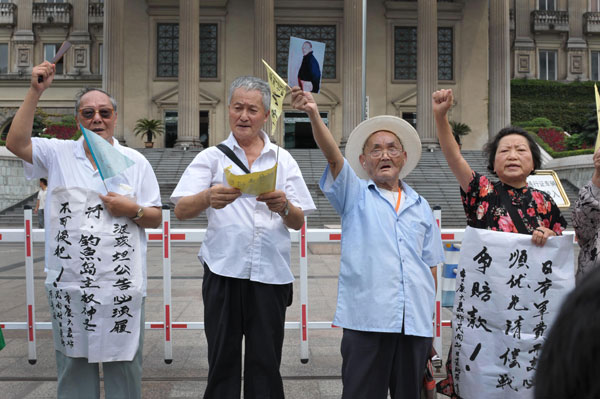 Survivors of the Japanese mass bombing of Chongqing, between 1938 and 1944, protest outside a Chongqing court against Japan's wartime actions and Tokyo's plan to "nationalize" China's Diaoyu Islands on Monday. Survivors of the bombing have filed a lawsuit against Tokyo. Yu Changjiang / For China Daily |
Beijing slams Tokyo's decision to 'purchase' Diaoyu Islands
Premier Wen Jiabao said China will "make absolutely no concession" on territory after Japan's decision on Monday to "nationalize" the Diaoyu Islands.
Tokyo's decision sparked a focused and determined response from Beijing, including the possibility, experts said, that territorial coordinates, clearly defining the islands' geographic location, could be sent to the United Nations.
Top legislator Wu Bangguo, on a visit to Iran, also reiterated Beijing's stance that the islands belong to China and have for centuries.
Wen's remarks came a day after President Hu Jintao told Japanese Prime Minister Yoshihiko Noda, during an encounter at the APEC summit, that "Japan must realize the seriousness of the situation".
Observers of ties between Asia's largest economies said Beijing has, for the first time, placed extra emphasis on territorial sovereignty over waters around the islands, in a "powerful response" to Japan.
The risk has increased that Sino-Japanese relations will spiral out of control over the issue, they said.
The Japanese government officially decided to "purchase" the islands on Monday afternoon and Osamu Fujimura, chief cabinet secretary, said the aim was to "nationalize" the uninhabited islands in the East China Sea as soon as possible.
Fujimura did not disclose the purchase price, but Japanese media reported last week that the government was set to pay 2.05 billion yen ($26.26 million).
The deal is likely to be finalized on Tuesday.
China-Japan ties have been strained since Shintaro Ishihara, the right-wing Tokyo governor, unveiled plans on behalf of the city government to "buy" the islands in April.
Noda announced a plan in July to "nationalize" the islands, a move that prompted immediate protests from Beijing.
In response to the developments, Beijing announced territorial coordinates — base points and baselines — for waters off the islands.
It also announced plans to implement "normalized surveillance and monitoring" of the islands.
Diaoyu: Strong protests lodged
The Foreign Ministry said in a statement that records show the islands were first found, named and used by the Chinese, and have been included in China's maritime defense sphere since the Ming Dynasty (1368-1644).
Japan seized the islands through illegal means at the end of the Sino-Japanese War (1894-95). But two key declarations during World War II, Cairo and Potsdam, legally returned the islands to China, the statement said.
Japan's stance on the islands is a blatant denial of the victory of a global anti-fascist war and a serious challenge to the post-war international order, the statement said.
Foreign Minister Yang Jiechi also summoned, and made representations to, Japanese Ambassador to China Uichiro Niwa on Monday.
The unilateral measures that Japan has taken are "illegal and ineffective", he said.
"China strongly urges Japan to immediately revoke the wrong decision to 'buy' the islands ... Otherwise, consequences arising from it can only be shouldered by Japan."
China's Ambassador to Japan Cheng Yonghua also made representations and submitted a note of protest to Japan's Foreign Ministry.
In Beijing, Premier Wen Jiabao said during a speech on Monday at the China Foreign Affairs University that the Diaoyu Islands are an inalienable part of China's territory and China will "absolutely make no concession" on issues concerning its sovereignty and territorial integrity.
"The Chinese government and its people cherish their country's hard-won national sovereignty and dignity more than anybody," Wen told the students.
This is the first time the Chinese government has placed extra emphasis on sovereignty over its territorial waters around the islands, and sovereignty rights in the waters, said Zhang Haiwen, deputy director of the China Institute for Marine Affairs.
"The baselines and base points define the territorial land and waters of the islands, and will further help nail down relevant exclusive economic zones," Zhang said.
Beijing may immediately submit the definitions to the United Nations secretary-general, she added.
Shi Yinhong, an expert on international politics at Renmin University of China said the move enhances the legal basis to back China's assertion of sovereignty over the islands, and is a "powerful response" to Japan's illegal attempt to "nationalize" them.
"We have to be prepared for Japan's looming sovereignty infringement in a strategic way, involving all kinds of measures, including defensive ones," Shi said.
The major task for Beijing, Shi said, is to prevent Tokyo "reaching for a yard after taking an inch" when encroaching on Chinese territory, he said.
The Japanese government and right-wingers share the same beliefs on the islands, said Gao Hong, deputy director of the Chinese Academy of Social Sciences' Institute of Japanese Studies.
"Although the Japanese government insisted that there would be fewer risks if they 'bought' the islands instead of Ishihara, there is no essential difference between the Japanese government's plan and Ishihara's claim."
Qu Xing, head of the China Institute of International Studies, said there would be long-term complications if the Japanese government managed to "buy" the islands. It will leave less room for diplomacy, Qu said.
Contact the writers at lixiaokun@chinadaily.com.cn and zhangyunbi@chinadaily.com.cn
Xinhua contributed to this story.


Copyright 1995 - . All rights reserved. The content (including but not limited to text, photo, multimedia information, etc) published in this site belongs to China Daily Information Co (CDIC). Without written authorization from CDIC, such content shall not be republished or used in any form. Note: Browsers with 1024*768 or higher resolution are suggested for this site.
License for publishing multimedia online 0108263 Registration Number: 130349