Children who study in cities with their migrant worker parents will get fairer opportunities in the cutthroat college entrance exam, Minister of Education Yuan Guiren said on Thursday.
Yuan said the ministry is urging local education authorities to release plans by the end of this year to enable migrant workers' children to take the exam, also known as gaokao, in the city where they live.
So far, students can attend primary school and middle school in the city where their parents work and live, but they have to go back to their hometowns where they have hukou, or a permanent residence permit, to attend gaokao.
 |
|
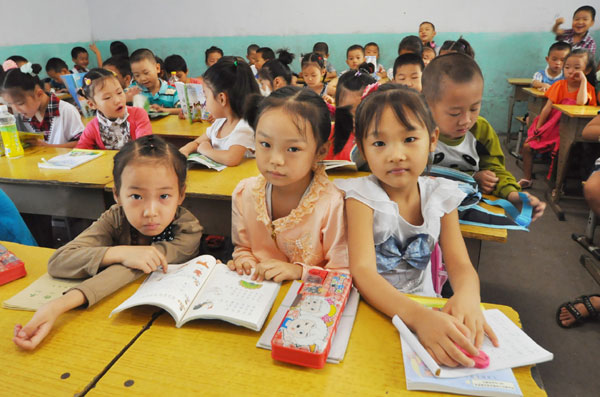
Pupils wait for class to start at Dequan Primary School, the largest school for children from migrant worker families in Zhengzhou, Henan province, on Monday, the first day of the new semester. Zhang Tao / for China Daily |
However, as Chinese colleges have different enrollment scores for students from different parts of the country, the scores in the hometowns of the migrant students are usually higher than in large cities like Beijing and Shanghai. The inequity has been a hot social topic for years.
Yuan said that amid China's fast industrialization the country has 245 million migrant workers and more than 20 million children who follow their parents to the cities. In addition, the country also has more than 10 million children left behind in rural areas.
"Such a large number of students cannot take the college entrance exam in the cities where their parents work and live. We should be aware of its significance and urgency," Yuan said at a news conference.
On Aug 30, the State Council published a notice setting out general principles on lifting hukou restrictions for gaokao sitters.
Yuan said although the government plans to lift the hukou restriction, there are still criteria for parents and students. The parents must have stable jobs and accommodation in the city, and tax and insurance records, and the children's school registration will show whether they are living and studying in a city, or just moving in for gaokao.
Also, Yuan said, the ministry will allow local governments in different cities and provinces to set their own policies, because the population capacities and education resources vary in different regions.
Tan Songhua, a member of the National Education Advisory Committee and one of the key architects of the gaokao system, said this is the third attempt by the government to enhance education fairness for migrant workers' children.
He said the education authority published policies in 2001 and 2003 to allow children to receive education outside their hukou regions.
Currently, 79.4 percent of children who follow their parents to the city are studying in public schools, 10 percent in private schools and 3 percent in schools built by migrant workers on their own, according to official figures.
"This new policy is an extension of the previous two, but the attempt to remove gaokao restriction is complicated, especially in large cities where there are more education resources," Tan said.
"For example, in Beijing, Shanghai and the Pearl River Delta region, education resources are abundant but the population is also dense, so the local governments have to set their own thresholds," Tan said.
Tan also said some regions are carrying out pilot projects to organize several college entrance exams a year, which helps to reduce the severe competition in gaokao.
"That may be a new direction in the future," he said.
Contact the writer at chengyingqi@chinadaily.com.cn


Copyright 1995 - . All rights reserved. The content (including but not limited to text, photo, multimedia information, etc) published in this site belongs to China Daily Information Co (CDIC). Without written authorization from CDIC, such content shall not be republished or used in any form. Note: Browsers with 1024*768 or higher resolution are suggested for this site.
License for publishing multimedia online 0108263 Registration Number: 130349