A new system to improve the movement at checkpoints of Shenzhen children traveling to Hong Kong for school had a rocky start on Monday, as thousand of students had failed to register for the new system ahead of the first day of school.
Up to 17,000 Shenzhen students are expected to travel to Hong Kong for school this semester. To ease the pressure on checkpoints processing the students, a digital bar code system has been introduced. The bar code is put onto the students' personal documents, allowing them to pass the checkpoint in a few seconds instead of waiting for customs staff members to stamp their documents.
The majority of cross-boundary students are kindergarten age, with the youngest only two years old, according to official statistics.
 |
|
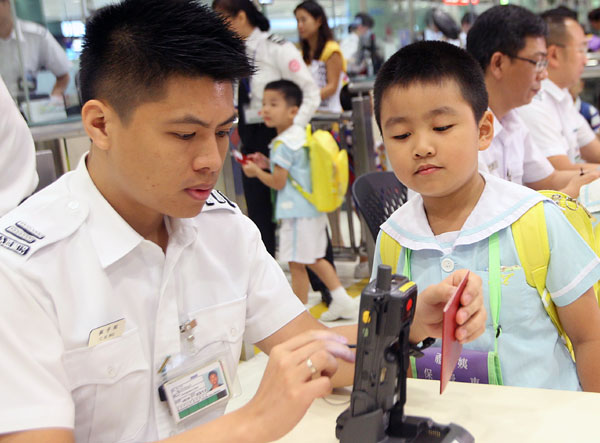
A pupil, living in Shenzhen, seems intrigued as he undergoes security clearance on his way to school in Hong Kong on Monday. Fast-track clearance at the Lok Ma Chau control point was set up to allow easier passage for children of families living in Shenzhen but entitled to a Hong Kong education through birth. Photo by Edmond Tang / China Daily |
On Monday, registered students were allowed to stay on cross-boundary "nanny buses" when crossing the border at three major ports, Huanggang, Wenjindu and Shatoujiao, as customs staff members boarded the buses with a digital reader device to scan the children's bar codes.
Some 1000 students enjoyed the new "on-bus checking" method on Monday. The time taken to cross the border was estimated to have been reduced by half.
"The on-bus method was absolutely good news for the young students. It reduced potential dangers when students get on and off the bus and when they have to walk through the port hall by themselves," said Chan Yee-wa, president of the Elite Kids Anglo-Chinese Kindergarten, in northern Hong Kong's Tin Shui Wai district.
However, despite the new system, many students were late for their first day of school.
"I heard that it was chaos at the checking point (on Monday)," Chan said.
Only 1,600 students out of the 17,000 traveling to Hong Kong for school had applied for the digital bar code. The students who did not have the bar code had to use the old way to cross the border, spending more than an hour waiting for approval stamps.
Eighty percent of cross-boundary students, were late for school on Monday.
Cui, a Shenzhen mother in her 30s who declined to give her last name, accompanied her five-year-old son, Zhang Mingju, to school on Sunday. Having not registered for the digital bar code, the mother and son had to go through the old way to cross the boarder. Cui described the procedure "terrible and miserable".
They woke up at 5:30 am to reach the Futian Check Point by 8 am, and then spent an hour and a half waiting to cross the border.
Cui and Zhang Mingju then took the nanny bus for cross-boundary students, arriving at the Elite Kids Anglo-Chinese Kindergarten at 10 am, one hour behind schedule. School ended at 12 am, and they then spent another four hours traveling home.
"From 5:30 am to 4 pm, we spent eight hours traveling yet studied for only two hours," said Cui.
"There are so many cross-boundary students at the check point; if you didn't register for the digital code, it was a long, long, torturous way to school," said Cui, appealing to the government to further promote the new way of crossing the border.
Many students, especially those born to mainland parents, were disconnected from news in Hong Kong over the summer vacation, and were not aware they could register for the digital code.
"We made many phone calls to ask parents to register for the new way to cross the border, yet many of them were out of reach over the summer," said a spokesperson for the Association of Shenzhen-Hong Kong Cross-boundary Nanny Bus Companies, whose bus companies serve more than 1,000 such Hong Kong students to mainland parents.
Due to a lack of communication between Hong Kong schools and mainland parents, the nanny bus agencies took on many responsibilities in addition to taking students to and from school, including applying for the advanced digital code for the students.
michelle@chinadailyhk.com


Copyright 1995 - . All rights reserved. The content (including but not limited to text, photo, multimedia information, etc) published in this site belongs to China Daily Information Co (CDIC). Without written authorization from CDIC, such content shall not be republished or used in any form. Note: Browsers with 1024*768 or higher resolution are suggested for this site.
License for publishing multimedia online 0108263 Registration Number: 130349