|
|
|
 |
|
|
|||||||||
BEIJING - China faces a tougher situation in water resources in the future as demand increases amid the country's rapid industrialization and urbanization, an official said Thursday at a press conference.
Hu Siyi, vice minister of water resources, said water shortages, serious river pollution and the deteriorating aquatic ecology are "quite outstanding" and may threaten the country's sustainable growth.
|
 |
|
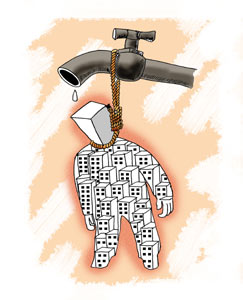
Cartoon by Yin Zhengyi/cartoon.chinadaily.com.cn
|
With a population of 1.3 billion people, China now consumes more than 600 billion cubic meters of water a year, or about three-quarters of its exploitable water resources, Hu said.
"Because of the grave situation, we must put in place the strictest water resources management system," he said.
According to the Ministry of Water Resources, the average per capita of water resources is only 2,100 cubic meters annually, or about 28 percent of the world's average level.
About two-thirds of Chinese cities are water-needy, while nearly 300 million rural residents lack access to safe drinking water, leading to a national water shortage of over 50 billion cubic meters on average every year, Hu noted.
The ministry's data showed that 40 percent of Chinese rivers were seriously polluted and unfit for drinking after 75 billion tonnes of sewage and waste water were discharged in 2010.
Moreover, about one-fifth of the rivers are so polluted that their water quality is rated Category V. China rates its water quality from Category I to Category V, with Category V being too toxic even to touch.
Adding to the country's water safety pressure are ambitious development plans announced by local governments this year, which experts say will inevitably greatly increase water demand for industrial and residential use.
"Unless we take decisive and compulsory measures to stop the over-exploitation activities, the water shortage will get worse in the future," Hu said.
To address the problem, the State Council, or China's cabinet, unveiled a guideline on Thursday to regulate the use of water under "the strictest criteria," capping the maximum volume of water use at 700 billion cubic meters by the end of 2030.
According to the guideline, China will work to keep its total volume of water use below 670 billion cubic meters in 2020.
Also, the government will tighten its supervision over exploitation of underground water, further protect sources of drinking water, and restore the aquatic ecological system by introducing water-use licenses and other measures.
The central government has planned 4 trillion yuan ($634.9 billion) of investment in water resources conservation projects over the next 10 years, of which 1.8 trillion yuan will be invested during the 2011-2015 period.
Zhou Xuewen, chief planner with the Ministry of Water Resources, said he expects investment in water conservation projects in 2012 to exceed last year's 345.2 billion yuan, of which more than 140 billion yuan will be funded by the central government.
"It will be our top priority to ensure safe and adequate water supply for residential use," Zhou added.
Wu Ying, iPad, Jeremy Lin, Valentine's Day, Real Name, Whitney Houston, Syria,Iranian issue, Sanyan tourism, Giving birth in Hong Kong, Cadmium spill, housing policy
|
|

|
|

|

|