|
|
|
 |
|
|
|||||||||
China must increase its grain output by protecting arable land and avoid becoming too reliant on imports, a top agricultural policymaker said.
"China has managed to harvest more grain for eight consecutive years, however, the supply of some agricultural commodities, such as soybeans, cooking oil and cotton, now depends increasingly on the international market," said Chen Xiwen, director of the office for the Communist Party of China Central Committee's Leading Group on Rural Work.
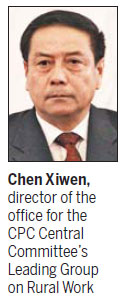 |
Chen was speaking on the sidelines of the annual session of Chinese People's Political Consultative Conference on Wednesday.
The country had record grain harvests amounting to 571 million tons in 2011, 4.5 percent more than the year before. But, Chen said the country also imported 61 million tons of grain last year, more than 80 percent of which was soybeans.
"Imported grains now equal to 10.7 percent of the domestic grain output. I am afraid this will affect grain security if the imported amount keeps increasing," he said.
China now imports more than 75 percent of the soybeans it needs from the US, Brazil, and Argentina, he said.
"If something that affects transportation happens to these countries, there will be grave problems," he said.
Also, growing reliance in the international grain market will affect grain prices, Chen said, noting that the import price rises for six items - soybeans, sugar, cotton, vegetable oil, pork and milk - exceeded the price rises in China.
Minister of Agriculture Han Changfu said earlier that China imported grain simply to enrich crop varieties in the domestic market, as he emphasized that the nation "will not and cannot" rely on imports to feed its 1.37 billion population.
China has managed to feed more than 20 percent of the world's population despite having less than 10 percent of its arable land, and it vows to meet about 95 percent of its food demand from domestic sources.
But weather-related disasters and some local governments' reliance on land transfer as a major revenue source poses threats to the country's grain security.
Chen urged that protection of arable land should "never be relaxed". He pointed out that some local governments are using the name of "land reform" to expropriate arable land, causing the arable land decrease in quantity and quality.
Meanwhile there are also voices calling out for more imports, as some experts think growing some kinds of grain is less efficient than importing them.
Liu Yonghao, chairman of the New Hope Group and a member of CPPCC National Committee, suggested that the country continue to control the trade in grain for human consumption but open imports of grains used in animal feed.
If we open up the import of maize, and use that to support the production of meat, eggs and milk, make them into value-added products for export, it would greatly benefit the agricultural sector, he said.
You may contact the writer at xieyu@chinadaily.com.cn
Wu Ying, iPad, Jeremy Lin, Valentine's Day, Real Name, Whitney Houston, Syria,Iranian issue, Sanyan tourism, Giving birth in Hong Kong, Cadmium spill, housing policy

|
|

|
|

|

|