Opera's highs make up for some lows
Updated: 2012-02-16 08:33
By Sun Ruisheng and Li Yao (China Daily)
|
|||||||||


His two sons, 29 and 27, are both married and work at factories on Taiyuan's outskirts. None of them can afford a theater ticket, which costs from 80 yuan to more than 1,000 yuan.
It's a similar situation that many other workers find themselves in.
So from Jan 27 to Feb 13, the Shanxi government arranged 14 shows at the Taiyuan Theater. Free tickets were also given to construction workers, miners and farmers.
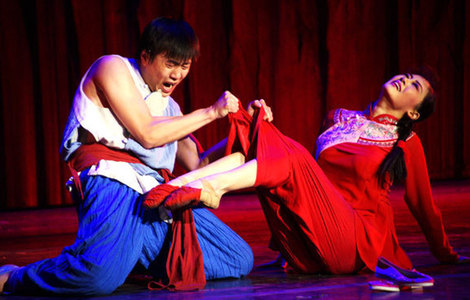
Regular opera-goer Ma Bingguang, 75, watched one of the shows, a dance drama called Opera Warriors.
"I am proud of Shanxi," said the retired Beijing professor who spent his formative years in Taiyuan during the 1950s.
"Coal mines used to be what the province was known for. Now the time has come for a cultural boom."
The Taiyuan Theater, built with an investment of 790 million yuan, is applauded by Ma for its blending of modern architectural design with traditional components. But cultural events should be made more accessible and affordable for lower-income groups, he said.
Shanxi has won state awards for reforms to its cultural industry for the past two years. From 2006 to 2010, the sector saw an annual growth rate of 25 percent, higher than the national average.
During the same period, Shanxi government invested 170 million yuan and received 100.29 million yuan from the central government for the protection and restoration of its cultural heritage.
There was also a fund promoting sustainable usage of coal resources that allocated 46 million yuan in support of cultural organizations and events.
Hefty investments were made to modernize public facilities, including the construction of Taiyuan Theater, and with an investment of 350 million yuan, the provincial library was able to expand its collection from 2 million to 7 million books and space to accommodate 3,000 people at a time.
Shanxi's tourism revenues exceeded 100 billion yuan for the first time in 2011, with a year-on-year increase rate of more than 20 percent, and the forecast for 2012 stands at 130 billion yuan.
Yuan Chunqing, the Shanxi provincial Party chief, talked about his vision at a working conference last July of transforming the cultural sector into a new engine of economic progress and making Shanxi home to more influential companies, cultural masterpieces, tourism hotspots and famous brands.
Early in May 2010, Wang Jun, the Shanxi governor, said the province will learn from its experiences in integrating the coal industry while now tapping into its rich cultural resources.
The provincial government announced the agenda from 2012 to 2015 at a meeting on Dec 28, with the cultural sector projected to be worth 100 billion yuan, accounting for 5 percent of Shanxi's GDP. It currently stands at 3 percent.
Wang Jinghua, 40, head of Huajin dance troupe that presented Opera Warriors, said the show was well received when it premiered in Beijing and Shanghai in November.
The dance drama will go back to Beijing and show at the National Center for the Performing Arts from March 7 to 10, before heading to Jiangsu and Zhejiang provinces in April.
Its appeal has also gone international. The troupe is due to perform in Australian cities in July and Hong Kong, Macao and Taiwan have shown interest.
This follows on the success of their previous dance drama, Forbidden Love under the Great Wall, a Chinese version of Romeo and Juliet, which it performed in Japan, Australia, Russia and the United States.
But Wang has also taken the troupe to many small counties and townships in Shanxi, following the provincial government's call to enrich grassroots cultural life.
"At the beginning of the show, we hear people chatting, yawning or eating snacks," she said. "But after a few minutes, they quickly quieten down and become absorbed in the performance."
But Wang said the ticket prices were too expensive considering the incomes of most small-town residents.
"When performing abroad, I found the prices were more reasonable and lower-income people could also afford to go to the theater - sometimes throughout the year," Wang said.
"In the future, I'd like to have more say in theater ticket prices when staging a show, so that a family with modest means can also enjoy our performances."





Hot Topics
Wu Ying, iPad, Jeremy Lin, Valentine's Day,Real Name,Whitney Houston,Syria,Iranian issue,Sanyan tourism,Giving birth in Hong Kong,Cadmium spill,housing policy
Editor's Picks
|
|
|
|
|

|