Financial officials changed in major reshuffle
Updated: 2011-10-31 07:17
By Hu Yuanyuan (China Daily)
|
|||||||||||


Retirement age key reason for senior figures leaving office
BEIJING - New banking, securities and insurance regulators have been appointed in the biggest reshuffle of financial officials for almost a decade.
|
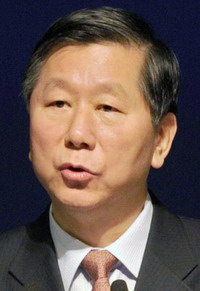 Shang Fulin, chairman of the?China Banking Regulatory Commission
|
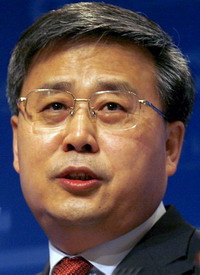 Guo Shuqing, chairman of China Securities Regulatory Commission
|
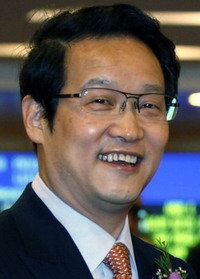
Xiang Junbo, chairman of the China Insurance Regulatory Commission |
Shang Fulin, 59, former chairman of the China Securities Regulatory Commission (CSRC), replaces Liu Mingkang, 65, as chairman of the China Banking Regulatory Commission, according to the Xinhua News Agency which quoted an unidentified spokesman with the Communist Party of China (CPC) Central Committee's Organization Department as saying on Saturday.
Guo Shuqing, 55, former board chairman of the China Construction Bank (CCB) and a former head of the State Administration of Foreign Exchange (SAFE), takes over from Shang as securities regulator.
In addition, Xiang Junbo, 54, the former board chairman at the Agricultural Bank of China (ABC), replaced Wu Dingfu, 65, as chairman of the China Insurance Regulatory Commission (CIRC).
The CCB and the ABC are among the country's four largest State-owned banks.
Age was the key factor behind the reshuffle, analysts said. Both Liu and Wu have reached the compulsory retirement age of 65 for senior government officials.
Guo, a former academic known for his down-to-earth demeanor, will find his new role at the China Securities Regulatory Commission gives him with an opportunity to put his knowledge of global finance to good use for the benefit of the capital markets.
Guo has taken some crucial decisions over a three-decade career, including asking CCB shareholders last year to cough up billions to recapitalize the bank after a State-led lending binge in 2009 to prop up China's economy during the global downturn.
"Guo is a politician who also has a profound understanding of the global economy," a CCB source, requesting anonymity, said. "He may not be familiar with every aspect of the banking business, but he has a long-term vision that has placed customer-service at the core."
The philosophy major and Oxford-educated scholar, who speaks English fluently, has moved easily between academia, government and a rapidly growing commercial sector that has helped China become the world's second-biggest economy.
Guo, a native of the Inner Mongolia autonomous region, says he washes up the dishes at home most days.
"I don't want to use a dishwasher and waste water or electricity," he said in an interview with Reuters.
A pragmatist, Guo studied for a master's degree in Marxist and Leninist theory, writing a thesis entitled "Thoughts About Certain Fundamental Problems in China's Economy" that cautioned of grave risks in using Western macro-economics theories in a China which had just begun to embrace reform.
The new securities regulator has published several books on China's economy, including one co-authored with Zhou Xiaochuan, head of the central bank.
His ascent through the ranks of the financial elite saw him serve as vice-governor of inland Guizhou province, and later as chairman of the country's foreign exchange regulator, the State Administration of Foreign Exchange from 2001 to 2005.
Guo came in for criticism while at SAFE for using taxpayers' money to bail out the major lenders in an attempt to make them more market-oriented.
He joined CCB, which counts Bank of America as a strategic shareholder, as chairman in 2005 after SAFE's $22.5 billion bailout left the agency as the bank's largest shareholder.
Seven months after Guo took over, CCB sold shares publicly for the first time in Hong Kong and two years later in Shanghai, making it the first State-owned Chinese lender to float shares in both bourses.
China's financial markets have achieved impressive growth in recent years. The country overcame a $650 billion bailout of State-owned banks and a five-year bear market to become home to the world's two biggest lenders and the third-largest stock market by value.
"China's financial industries have seen tremendous changes and the new regulators are facing a much better starting point than 10 years ago, when the banks were seen as technically insolvent and the stock market was chaotic," Bloomberg cited May Yan, a Hong Kong-based analyst at Barclays Capital as saying before the announcement.
Shang became chairman of the CSRC in December 2002. Prior to that, he served from 2000 to 2002 as president of the ABC and was a deputy governor at the central bank from 1994 to 1996.
Liu became head of the banking regulatory commission in March 2003, and Wu was appointed head of the CIRC in November 2002.
Xiang was a State auditor and deputy central bank governor before joining the ABC in 2007 to lead the restructuring. An initial public offering three years later raised $22.1 billion in the world's largest first-time sale.
Bloomberg and Reuters contributed to this story.






Hot Topics
Libya conflict, Gaddafi, Oil spill, Palace Museum scandal, Inflation, Japan's new PM, Trapped miners, Mooncake tax, Weekly photos, Hurricane Irene
Editor's Picks

|

|

|

|

|
|