Guardian of the relics
Updated: 2011-10-30 07:48
By Lu Chang (China Daily)
|
|||||||||||


|
Fan Jinshi, 73, has worked with the Dunhuang Academy since she graduated from Peking University with an archeology degree in 1963. After living in Gansu for five decades, Hangzhou native Fan says she feels she already belongs here. Sun Zhijun / for China Daily |
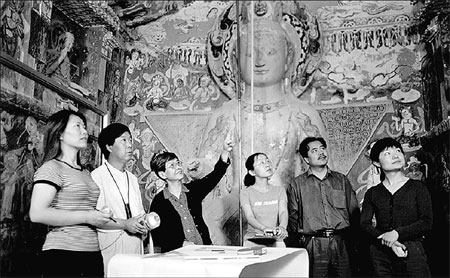

Archaeologist's dedication helps preserve exquisite murals and painted sculptures of the Mogao Grottoes. Lu Chang has the story.
Fan Jinshi didn't set out to be the guardian of the treasures of the Silk Road. When she first went to Dunhuang, Gansu province, the petite archeologist never imagined she would spend a year living alone in the forsaken outpost with no running water, no electricity or even a decent toilet.
But five decades have passed, and the 73-year-old Hangzhou native is still there, leading her team in the research and preservation of the 1,600-year-old Mogao Grottoes in Dunhuang, a desert city in China's Northwest Gansu province.
"I came here for a very simple reason," says Fan, who was assigned to work at the Dunhuang Academy after she graduated in archeology from Peking University in 1963. "Back then, things were very different - houses, beds and chairs, everything seemed to be made out of mud.
"But being an extraordinary scholar means that one has to spend years in toil and solitude," she says. "And the longer I stayed here, the more I felt I belonged here, and that may explain why I've ended up being here nearly all my life."
After all these years, her eyes still sparkle every time she talks about the grottoes, which are covered with elaborate Buddhist murals portraying visions of heaven and earth. The cave interiors are also adorned with more than 2,000 sculptures, some of them among the finest of their era.
"It has been called Mogaoku, or 'peerless caves', but no name can fully capture their beauty or immensity," says the acclaimed "Daughter of Dunhuang".
"The caves were once a transit point of the Silk Road. Actually when you look at the paintings, you can still see the mingling of Chinese and foreign elements on almost every grotto wall."
But Mogao's murals have always been fragile, Fan says, the thinnest tissue of paint caught in a corrosive battle between sand, rock and air. Since 1998, when she was elected president of the 67-year-old academy, Fan has faced a dilemma - how to conserve the caves while exposing them to a wider audience.
"The conflict between economic development and conservation is everywhere. If we don't pay enough attention, it will be the cultural site that loses the battle," says Fan, who, with an iron hand, found a way to solve the problem and help lead the way for other Chinese sites.
To contain tourists' impact, conserve and promote the Dunhuang Mogao Grottoes, a World Heritage Site since 1987, Fan has promoted a series of long-term initiatives, such as building archives to conserve the images of all the paintings through digital technologies and a visitor center including documentary rooms and high-fidelity replicas of the caves.
"This is a very important step in the future direction of visitor management and education for the general public," says Neville Agnew, a senior specialist of the US Getty Conservation Institute. "The management of visitors integrated with the reservation and booking systems for the visitor center will provide a model, not only for China, but elsewhere in the world, ensuring both preservation of the site and a first-class visitor experience."
Fan has also enlisted the help of teams of experts from across Asia, Europe and the United States on the research of the local environment, conservation, staff exchange, training and conservation education.
A teaching program with the Courtauld Institute of Art in London is part of the effort in gaining international cooperation.
Every year professionals from the Dunhuang Academy participate in courses organized by the institute in wall-painting conservation for two or three months.
"What director Fan has done in Dunhuang is that she has taken a real initiative to look at the big problems, from both natural and human perspectives," says Sharon Cather, a professor of wall painting conservation at the Courtauld Institute of Art.
With the help of international cooperation and training, Fan has fostered a strong group of professional researchers and technicians. Of the more than 260 researchers and conservationists at the academy, about 90 percent are aged between 30 and 50.
For more than two decades until 1986, Fan lived and worked at Dunhuang, far from her husband, two sons and her parents in Wuhan, Hubei province. Her husband Peng Jinzhang followed her to Dunhuang later.
"For many researchers who are working here, we all have the same dream, to preserve the heritage and also make it available and interpreted for the whole world," says Fan, who has also been a key editor of papers, books and publications on Dunhuang over the years.
"No relics can live forever, but it's our job to prolong their lifespan, because the value they have is not just for the Chinese but for everybody."
You can contact the writer at sundayed@chinadaily.com.cn.







Hot Topics
Libya conflict, Gaddafi, Oil spill, Palace Museum scandal, Inflation, Japan's new PM, Trapped miners, Mooncake tax, Weekly photos, Hurricane Irene
Editor's Picks

|

|

|

|

|

|