China's legal system gets refined
Updated: 2011-10-28 07:51
By Wang Huazhong and Zhao Yinan (China Daily)
|
|||||||||||


BEIJING - The country's top legislature is removing and modifying "a great number of" administrative and local regulations that run contradictory to the Constitution and national laws, a senior legislator said on Thursday.
"We're cleaning up a great deal of such regulations ... that implicate local interests in every provincial-level administrative region," said Xin Chunying, deputy director of the legislative affairs commission of the National People's Congress (NPC) Standing Committee.
She said the exact number of such regulations will be released when the job is done.
Xin released the information at a news conference that introduced a white paper titled The Socialist System of Laws with Chinese Characteristics.
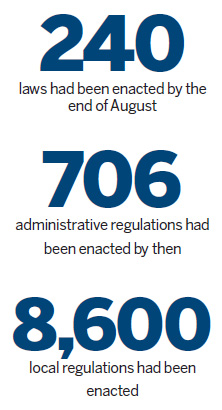
By the end of August, the Chinese legislature had enacted 240 laws, including the current Constitution, 706 administrative regulations and more than 8,600 local regulations, according to official figures.
The Constitution has the supreme legal power, followed by laws adopted by the NPC. Administrative rules passed by the State Council and regulations adopted by local governments. Though all have legal validity, they must not go against the Constitution and laws, according to the Legislation Law.
Commenting on the reasons for the check-ups, Xin said: "One of the important goals of the Constitution is maintaining unification of the legal system, and protecting legal authorities."
Han Dayuan, a law professor with Renmin University of China, said although the NPC has made great efforts to clean up contradictory regulations, the work can be hard due to resistance from local governments and the complexity of the issue itself.For instance, Han said, authorities are reluctant to modify their departmental and local regulations to fit the newly revised Administrative Coercion Law, a ruling that was passed in June to curb the power of government organs and prevent abuse of power.
"The country outlawed forced demolition during holidays and at night time in the Administrative Coercion Law, but some local government still carry out the practice, since it will be much easier for them to fulfill their mission," Han said.
Two buildings in a Beijing-based industrial park were torn down at around 9 pm last Sunday, and four employers of the park suffered injuries to their heads and arms, Beijing Times reported.
The park manager, surnamed Yu, told Beijing News that they invested about 80 million yuan ($12.6 million) into the buildings and the compensation is too low to cover the loss.
When asked what would happen if local governments resist such changes, Xin said the overhaul will be "carried out according to laws".
According to the white paper, China's legal system is an organic integration of the related laws of the Constitution, civil and commercial laws, administrative laws, economic laws, social laws, criminal laws, litigation and non-litigation procedural laws and other legal branches.
While maintaining its stability, the Constitution is constantly improving and advancing with the times along with the reform and opening-up and the progress of the cause of socialist modernization, says the white paper.








Hot Topics
Libya conflict, Gaddafi, Oil spill, Palace Museum scandal, Inflation, Japan's new PM, Trapped miners, Mooncake tax, Weekly photos, Hurricane Irene
Editor's Picks
|
|

|
|

|

|