Taoist forum looks at environment
Updated: 2011-10-24 07:53
By Li Yao (China Daily)
|
|||||||||||


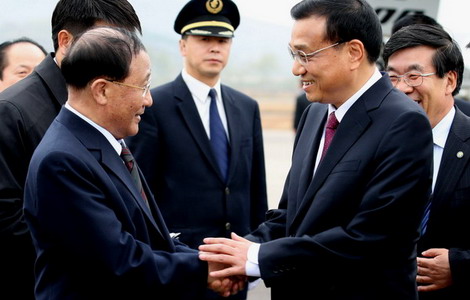
HENGSHAN, Hunan - An international Taoism forum opened on Sunday, attracting 500 scholars from 21 countries and regions to Hengshan Mountain, a sacred Taoist site in Central China's Hunan province.
Liu Yunshan, head of the Publicity Department of the Central Committee of the Communist Party of China (CPC), announced the opening of the forum.
Du Qinglin, head of the United Front Work Department of the CPC Central Committee, addressed the opening ceremony. He said the Taoist emphasis on harmonious co-existence between people and nature had growing relevance in the contemporary world.
In recognition of the growing Taoist influence in modern China, the forum will focus on how to integrate Taoist philosophy with social reality and share Taoist wisdom and concerns about sustainable development, the pursuit of happiness and progress through cooperation, and protecting spiritual well-being in seminars on Monday and Tuesday.
Prominent guest speakers include Bawa Jain, secretary-general of the World Council of Religious Leaders, Martin Palmer, a British environmental activist and director of the Alliance of Religions and Conservation, and Ren Farong, head of the Chinese Taoist Association (CTA).
Global celebrities including Prince Philip of the United Kingdom sent congratulations to the opening of the forum.
Xu Jialu, a retired vice-chairman of the Standing Committee of the National People's Congress, and Palmer are scheduled to make a live TV appearance on Monday evening, exchanging eastern and western perspectives about harmony between nature and human beings.
In an interview with the Union of Catholic Asian News earlier this month, Palmer said that the Taoist "message of simplicity, respect for nature, humility and striving for a proper balance is perhaps more important than at any time in China's history", and he said that he considered the forum "a powerful indication that China is looking for ways to protect its nature as well as its people".
Delegates from Hong Kong, Macao, Taiwan and the Chinese mainland will hold discussions live on TV on Tuesday, exploring opportunities to strengthen existing ties among Taoist circles in these regions and taking stock of religious pluralism in China as exemplified by the syncretism of Taoist, Buddhist and Confucianism.
Leaders of Taoism associations in the United States and Europe - including Germany, France, Spain and Italy - will have small brainstorming sessions about how to broaden Taoism's global appeal.
The three-day forum is co-sponsored by the CTA and China Religious Culture Communication Association.
On the Chinese mainland, about 30, 000 Taoist monks live in temples, another 60,000 practitioners of Zhengyi Taoism are scattered throughout the country and five major institutes offer Taoism training, the organizers announced at a news conference on Saturday.
"Today, Taoist places of worship can be found in more and more countries. Many research institutes around the world show a growing interest in Taoism as a lens to study Oriental culture. Taoism will see its global influence spreading in the near future," Lin Zhou, vice-president of the CTA, said on Saturday.
Taoism, a philosophical and religious tradition that originated in China, seeks to establish harmony between human beings and the principle of the universe, which is called Tao. The emblem of Taoism is the tai chi symbol, which is a circle with an S-shaped line dividing the white (yang) and black (yin) halves.?
|
Deep roots Taoism is an indigenous traditional religion in China with a history of nearly 2,000 years. It has been one of the main components of Chinese traditional culture with deep roots in the Chinese people's customs and worldview. It is said that Tao is the origin of the universe, the basis of all existing things, and the law governing their development and change. The concept of virtue, de in Chinese, is closely related to Tao, commonly explained as the specific manifestation of Tao. Taoists regard Tao and de as the general principles of their beliefs and behavior. They should cultivate Tao and accumulate virtue. Taoism promotes achieving harmony with nature, the pursuit of virtue, self-development and spiritual immortality. It reflects traditional Chinese thinking that harmony generates and sameness stifles vitality. The Tao Te Ching by Laozi is Taoism's principal canon. Now one of the five major religions in China (the others are Buddhism, Catholicism, Islam and Protestantism), Taoism has a great number of followers. There are more than 1,600 temples and more than 25,000 Taoist priests. Source: Chinese Taoist Association |







Hot Topics
Libya conflict, Gaddafi, Oil spill, Palace Museum scandal, Inflation, Japan's new PM, Trapped miners, Mooncake tax, Weekly photos, Hurricane Irene
Editor's Picks

|
|
|

|

|

|