|
|||||||||||


BEIJING - China's migrant population now numbers 221 million, or 16.5 percent of all citizens, and as the numbers grow so do the problems these people face.
Most migrants do not enjoy the same rights as local people and therefore face difficulties integrating into urban life, according to a government report issued on Sunday.
The 2011 Report on China's Migrant Population Development was issued by the National Population and Family Planning Commission and will serve as a guide for the central government as it formulates plans for urbanization and population management.
|
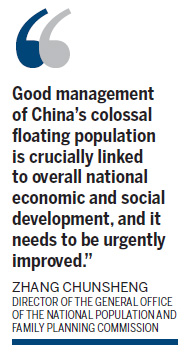 |
"Good management of China's colossal floating population is crucially linked to overall national economic and social development, and it needs to be urgently improved," said Zhang Chunsheng, director of the general office of the commission, at the launch of the report.
During the last three years, China's migrant population increased by about 10 million each year and another 300 million rural people are expected to move to urban areas in the next 30 years, the report said.
"With such large and rapid population shifts, China's urbanization is entering a critical period and its management has to be further strengthened to deal with emerging problems," Zhang said.
These problems include "city illness", which covers a series of social problems stemming from huge population movements into big cities, poverty, forced housing demolitions, and challenges to the sustainability of megacities in terms of natural resources and the environment, sound social management and supply of public services, experts said.
"Of these, the problems from a widening wealth gap between migrant workers and urbanites are crucial because they upset social stability," said Wang Qian, who heads the floating population management division of the commission.
According to the report, more than 76 percent of the new generation of migrant workers, who were mostly born after 1980, want to live permanently in the cities where they work but are seriously challenged by the high cost of urban life and poor access to welfare services such as education, medical treatment, housing and social security programs.
Some 4.5 percent of migrants make less than 500 yuan ($78) a month, 27 percent less than 1,000 yuan, and about 20 percent cannot afford to work and live in cities at all, it said.
Poor skills and little access to occupational training are mainly to blame for such low incomes, said Zhang.
Only 17.8 percent of migrants have received occupational or skills training from the government, the report said.
Based on lessons learned from the recent waves of urbanization, the central government has issued policies and introduced measures to help improve the lives of migrants.
These include basic health services and social security benefits provided at migrants' workplaces, Zhang said.
"Also, the central government has begun to regulate ruthless and poorly managed urbanization, ordering that it be done step by step with more regard to migrants' welfare," he said.
"That helps with social stability as well," said Li Tie, director of the city and township development research center at the National Development and Reform Commission.
Experts warned that the 2005 Paris riots were caused largely by mounting discontent from marginalized immigrants, most of whom were from Africa.
Related Stories
Young Chinese migrant workers more educated 2011-10-09 23:18
- Killers of 13 abducted Chinese sailors identified
- Two US economists win Nobel prize
- Mass migration, major problems
- Reports of J-10B jet crash untrue
- 13 Chinese sailors killed on Mekong
- Attack in Mekong kills 11 Chinese
- China celebrates centenary of 1911 Revolution
- Stricter rules over banking products








Hot Topics
Libya conflict, Gaddafi, Oil spill, Palace Museum scandal, Inflation, Japan's new PM, Trapped miners, Mooncake tax, Weekly photos, Hurricane Irene
Editor's Picks

|

|

|

|

|

|