Society
Plan accelerates car buying craze
By Cui Jia (China Daily)
Updated: 2010-12-16 07:03
 |
Large Medium Small |
Commuter options
 |
|
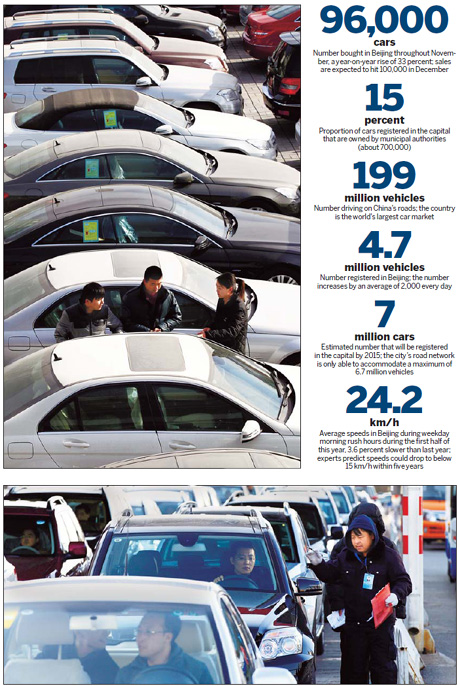
Top: Business is booming this month at Yayuncun Car Market, Beijing's biggest dealership, after plans were announced to restrict vehicle purchases in the capital from Jan 1. [Wang Jing / China Daily.] Above: Newly owners wait for routine vehicle checks at the city's Beiyuan testing center. [Feng Yongbin / China Daily] |
Officials with the commission of transport acknowledge that bus and subway networks in the capital are far less developed than in other international cities, such as London and New York (the subways in both cities are almost double the size of Beijing's).
According to the draft traffic management plan, municipal authorities will next year take various measures to improve public transport, including speeding up infrastructure construction.
"It's possible for public transport to thrive, even if there are more autos on the road, but it depends on the cost and ease of car ownership and the quality and availability of the alternative options," said Zhao at the China Academy of Urban Planning and Design.
In European countries and parts of the United States, he explained, car ownership may be widespread but operating costs - fuel prices, parking and sometimes congestion charges - are expensive, while parking is not so readily available.
Research has also shown that if commuters are offered incentives to ride public transport and services are reliable, car usage can be reduced.
Car owners do not perceive driving as the only way to get around, but rather as one option among many, said Zhao, who added: "Given a choice, people will choose the most appropriate and convenient mode of transport."
China overtook the US last year as the world's largest car market and now has 199 million vehicles on its roads, with another 20 million added every year, according to official statistics.
However, the nation's economic success (it has the second-largest economy) means it faces the policy equivalent of having one foot on the accelerator and one foot on the brake.
Although the central government has spent billions on roads and railways, two-thirds of cities suffer chronic congestion.
Beijing is arguably the most notorious for lengthy traffic jams. Cars and trucks often queue for hours in rush hours, and the gridlock looks set to only get worse. In August, hundreds of drivers endured a nine-day, 100-km jam caused by construction on a highway leading into Beijing.
Meanwhile, anti-car campaigners argue that the environmental and economic costs far outweigh the profits made by the auto industry.
Whether the capital can successfully cure its traffic ills remains to be seen, but one thing is certain: other major Chinese cities will be looking on with keen interest.