Society
Plan accelerates car buying craze
By Cui Jia (China Daily)
Updated: 2010-12-16 07:03
 |
Large Medium Small |
Slow going
 |
|
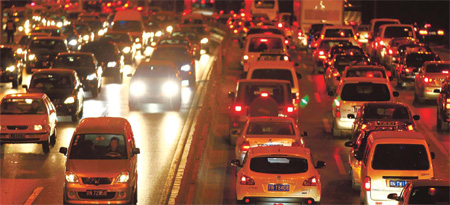
Commuters wait nose to tail on the Third Ring Road in Beijing during rush hour last weekend. Traffic congestion in many cities has severely worsened in the last few decades, with more cars adding to the problem every day. [Wang Jing / China Daily] |
Traffic conditions in Beijing have been worsening for decades. At first, commuters only complained about jams during rush hours, but today practically every hour is rush hour.
"Say 20 years ago, owning a car was just a dream for most Chinese. Now that more people have cars, the dream has truly become a nightmare," said taxi driver Wang Huidong, 56. "If the average life expectancy of Chinese is 70, Beijingers actually only get 50 years because we waste 20 in traffic jams.
"(The authorities) can keep adding highway lanes but people are already buying the cars to fill them with," he added.
Roughly 4.7 million vehicles are already on Beijing's roads, with an average of 2,000 more joining them every day, according to data from the city's commission of transport.
At this rate, by 2015, the city will have 7 million cars on a road network that can accommodate a maximum of 6.7 million vehicles - and that is only if the license plate ban that stops private cars from using urban roads for one working day stays in force.
Studies by the Beijing Transportation Research Center show that, if action is not taken to curb the current trend, average speeds will drop to below 15 kilometers an hour within five years.
Speeds in the first half of this year hovered around 24.2 km/h during weekday morning rush hours, 3.6 percent slower than last year.
Zhao Jie, director of the China Academy of Urban Planning and Design's transportation research institute, said poor city planning is largely to blame for Beijing's traffic woes.
"As more than 50 percent of businesses and government agencies are based in central areas, where property prices are high, people have to live far away from their workplaces," he said. "These commuters are forced to put up with a crowded and often unreliable public transport system and feel they have no choice but to buy cars."
Before governments start restricting personal car use, Zhou suggested city officials "build more subways and put more buses on the road to give people an attractive option".
Accountant and long-suffering commuter Liu Tao could not agree more.
The 28-year-old accountant lives in Tiantongyuan, a large apartment complex that houses 300,000 residents on the capital's northern outskirts, and makes a 52-km round trip to his office in the Central Business District every day.
When he moved in three years ago, he regularly traveled on the subway, taking Line 5 all the way to Guomao station, "but it drove me absolutely insane", he said.
"I had to wait for three or four trains to go by before I could squeeze on during rush hours", jostling for position with thousands of Tiantongyuan residents, recalled Liu, who hails from Jiangsu province. "I frequently had nightmares about being suffocated in an overcrowded subway train.
"Every day I prayed I would get out alive and in one piece."
Traumatized by his underground experience, Liu bought a car in 2008, swapping one daily grind for another. He now spends an average of five hours in traffic jams every day.
"If it's a choice between being trapped on the subway for three hours or stuck in traffic for five, I choose the latter. At least I have my own space," reasoned the accountant. "The government wants people to drive less but public transit is so unattractive. That's why the appeal won't work."