Society
For love or money
By Chihua Wen (China Daily)
Updated: 2010-08-04 07:56
 |
Large Medium Small |
|
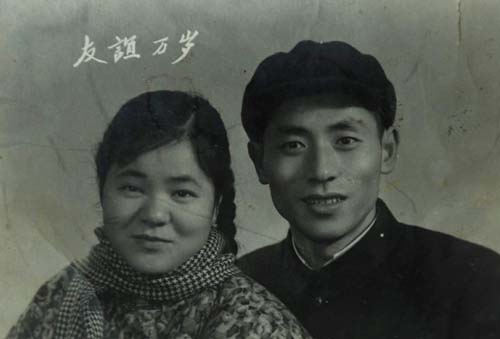 A wedding picture from the 1960s features Xiao Fa and his bride Li Cuiping from Hunan province. The Chinese characters are "You Yi Wan Sui", or "Long Live Friendship". |
Tong Zhuming (not his real name) was a military officer based in Urumqi, capital of the Xinjiang Uygur autonomous region, in 1970 aged 29, he sought permission to marry his girlfriend. It was denied after the military authorities found his girlfriend "political unreliable" as her uncle was in the United Sates. Instead, the authorities arranged for him to marry a miner's daughter from Tianjin.
"I seldom felt happy in this marriage," recalls Tong's wife, Tang. "I felt trapped. In those times, I couldn't ask for divorce because it was a military marriage."
A military marriage, between a civilian and the other a serviceman, was provided special legal protection: unless the serviceman agreed, the divorce would not be granted by a court.
|
||||


The 1980s saw marriage values in China taking a second turn.
In 1980, Yu Luojin, a writer in Beijing, filed for divorce, claiming she was no longer compatible with her husband. But, incompatibility was not legal grounds for divorce under the existing Marriage Law. The term incompatibility was so foreign that Yu's appeal triggered a social controversy about the reasons for divorce.
With Yu Luojin's case, the 30-year-old Marriage Law no longer met the needs of the contemporary social landscape.
In 1980, the first amendment to the Marriage Law was issued. Incompatibility was written into the articles of the new Marriage Law.
"People realized that love could be the reason for a marriage. They gradually gave up the old idea of sex as reserved for having children. They began to see sex as a way of expressing love and affection, and for the pleasure of body and soul," says Chen Mingxia.
Love, affection and enjoyment became the standard by which many people judged the quality of their marriage.
However, following the amendment to the Marriage Law, the 1980s witnessed an unprecedented divorce rate in China. Numerous couples, many of whom were sent to the countryside as teenagers during the "cultural revolution" (1966-76) and had marriages with local peasants for practical reasons, got divorced when they returned home after the revolution.
Later the influence of Western-style sexual liberation affected marriage stability and in the 1990s, some old practices returned.